E-commerce admin back office
Products, orders, shipments and customers already wired to a working mock API — the core of a Next.js e-commerce template's back end.
Atlas is a Next.js admin template and Next.js e-commerce template in one: a production-style static-export dashboard for products, orders, customers and shipments, built with Next.js 16, React 19 and Tailwind CSS v4 — no backend required to start.
Among the best Next.js templates for teams who want a working admin surface, not just a Next.js landing page template or a Next.js portfolio template: 32 real pages and 69 documented shadcn/ui (Base UI) components you can lift straight into your own Tailwind CSS templates.
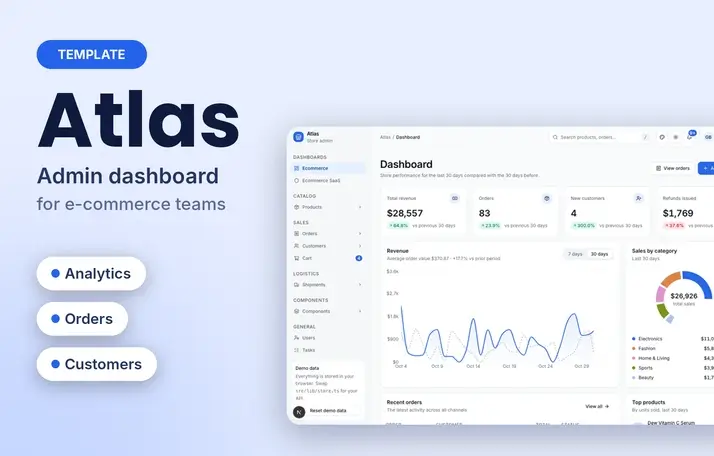
Most Next.js website templates on a marketplace are a single marketing page with a hero and a pricing table. Atlas is different on purpose: it is a Next.js dashboard template with 32 working pages — a KPI dashboard, a products catalog with four layouts, an orders board and invoice view, customer insights, shipment tracking, a cart, task board, user management and settings — wired to a mock data layer so every page works the moment you clone it.
It is built with Next.js 16's App Router, React 19 and Tailwind CSS v4 only, styled with shadcn/ui's Base UI variant instead of Radix. State lives in a zustand store synced across tabs, reads go through TanStack Query hooks, and every form is validated with Zod — the same stack you would reach for on a real product, not a demo.
Every card on this page links to a real, running page from the build. Open any of them in a new tab, then read the documentation to make Atlas yours.
Start from the page group that fits, then swap the mock data for a real API.
Products, orders, shipments and customers already wired to a working mock API — the core of a Next.js e-commerce template's back end.
Reuse the SaaS dashboard, users, tasks and settings pages as the operator console for your own product.
A fast internal dashboard for a small team — no backend needed on day one, since the mock data layer runs entirely in the browser.
Pair Atlas with Shopify, Medusa or your own commerce API by replacing src/lib/store/seed.ts with real requests.
OKLCH design tokens and a Base UI component set make re-theming for a client a matter of minutes, not a rebuild.
69 documented components double as a living library of Tailwind UI components for any other project.
Click any card to open the page in a new tab. They are real, built pages, not screenshots — grouped below so 32 pages and 69 components stay easy to scan.
The template demonstrates a full back-office workflow, from first login to invoice.
Revenue, orders and customer charts built with Recharts, driven by the same mock data as every other page.
A persisted store with synced tabs, read through typed query hooks — the exact swap point for a real API.
One set of OKLCH color variables, switched with a class and a data-accent attribute.
One validation schema per form in src/lib/validation/, shared by the product, shipment and customer editors.
next build writes plain HTML, CSS and JS to out/ — host it anywhere, no Node server required.
List, grid, gallery and a detail view — pick the one that fits.
A drag-ready Kanban view and a print-ready invoice layout, both from the same order data.
A dedicated analytics view per customer: lifetime value, order history and trend.
Atoms → molecules → organisms → features → app, dependencies only point upward.
Every primitive used across the 32 pages has its own documentation page — a real component library of Tailwind UI components built on Base UI.
Field, Input, Select, Combobox, Date Picker, OTP, Native Select and more.
Table, Data Table, Chart, Timeline, Calendar, Avatar, Badge, Kbd.
Dialog, Sheet, Drawer, Popover, Command, Context Menu, Navigation Menu, Sidebar.
Alert, Alert Dialog, Toast, Empty, Skeleton, Spinner, Progress.
Dashboards, products, orders, customers, shipments, auth and error pages.
Every primitive used across the app has its own doc page.
src/lib/store/seed.ts is the single mock-API adapter.
Static export, mock data, runs entirely client-side out of the box.
Small, well-maintained tools, each with one clear job.
cn() helper and variants32 app pages across dashboards, products, orders, customers, shipments, cart, users, tasks, settings, auth and error pages, plus 69 documented shadcn/ui components, built on Next.js 16, React 19 and Tailwind CSS v4.
Both. It is a Next.js admin template purpose-built around e-commerce back-office data — products, orders, shipments, customers — so it doubles as a general Next.js dashboard template for a SaaS admin panel or internal tool.
No. A zustand store seeded from JSON files in src/data/ powers every page. Replace src/lib/store/seed.ts with real API calls when you connect a backend.
No — Atlas uses shadcn/ui's Base UI variant for every interactive primitive instead of Radix, documented across the 69 component pages.
A Next.js landing page template or Next.js portfolio template markets a product or a person on one public page. Atlas is an authenticated-style admin surface — tables, forms, charts and CRUD-shaped views for managing real product data.
Yes. Colors are OKLCH CSS variables in src/styles/globals.css, switched with a data-accent attribute (blue, violet, emerald, rose, orange) and a dark class — a client re-brand is a token change.
Yes. The project root includes CLAUDE.md and AGENTS.md with the architecture, data flow, styling rules and checks, so tools such as Claude Code, Cursor, Codex and Copilot work with the template out of the box.
Get the template, follow the documentation and have your first page running in minutes.