
- The Day-to-Day Difference Developers Actually Feel
- Who Actually Uses Angular vs React — Real Patterns
- Feature Comparison for Admin Dashboards
- What Happens When Teams Switch Frameworks
- Honest Recommendation — Which One to Choose
- Templates for Both Frameworks
- Angular or React — the answer depends on what you're building
- Angular or React — We Have Templates for Both
I started my career as an Angular developer and built my first templates in Angular. Over time, I expanded to React and Next.js because customers needed it. I've now built and maintained production templates in both — which means I've seen firsthand what each framework feels like when a real project scales, a team grows, and things start getting complicated.
In short: The Angular vs React debate has been running for years and it still generates more heat than light. Most comparisons are written by people who have a preferred answer going in. This one isn't.
I've built admin dashboard templates in both Angular 22 and React 19. I've watched customers use them — I know which type of project buys which template, and I've seen what happens when teams switch frameworks midway through a project. That context changes the answer significantly depending on who's asking.
So here's the honest version.
The Day-to-Day Difference Developers Actually Feel
This is the question most comparisons avoid answering directly. Framework benchmarks and feature matrices are fine, but what matters is what it actually feels like to build something in each one day after day.
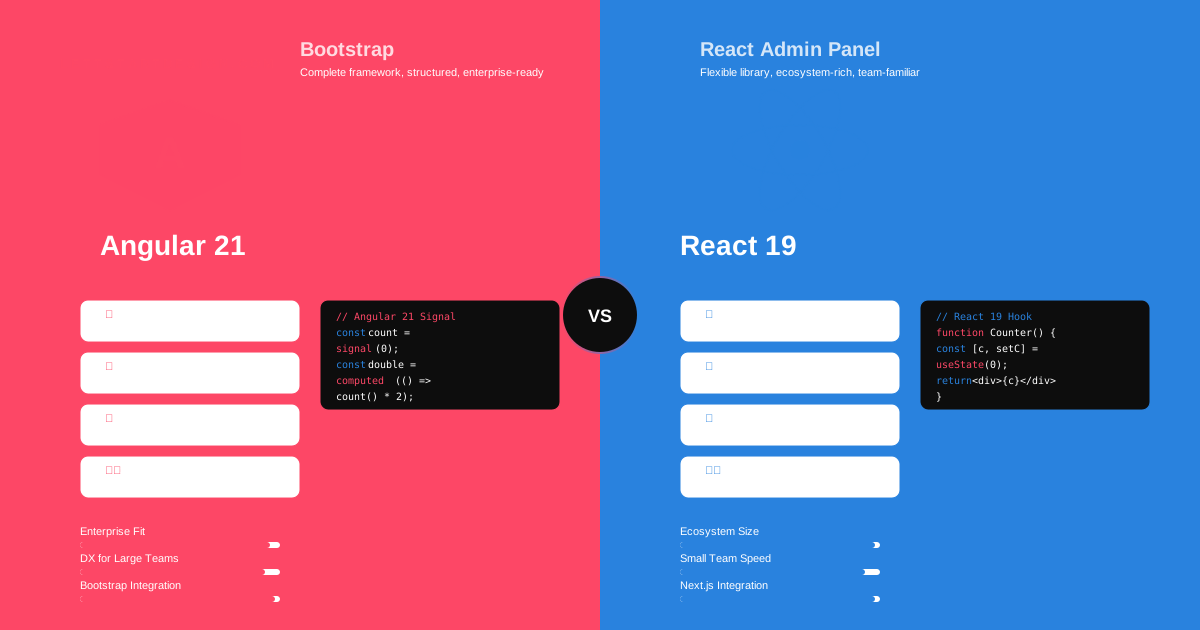
Angular is opinionated. Routing, dependency injection, forms, HTTP services, testing, and project structure are all defined by the framework. You don't spend much time deciding how to organise your application — Angular has already made those decisions for you. For a team, that's genuinely valuable. Everyone writes Angular the same way. A developer who joins six months into a project can read the existing code without needing a tour of the architecture decisions.
React gives you more freedom. You choose your own routing library, state management solution, data fetching approach, and project structure. That flexibility is real and powerful — but it also means every React project is slightly different from the last one. Patterns vary across teams and even across developers on the same team. For experienced developers, this is fine. For larger teams or long-term projects, it can quietly become a maintenance problem.
In practice: Angular developers tend to appreciate predictability. React developers tend to appreciate the ability to make their own choices. Both are valid preferences — they just suit different types of projects and teams.
🅰️ Angular 22 — What You Get
- Opinionated — conventions built in
- Routing, DI, forms all included
- Consistent patterns across the codebase
- TypeScript first — no configuration needed
- Signals for reactive local state
- Modern @if / @for control flow
- Standalone components — less NgModule overhead
- More setup time, less architecture debate
⚛️ React 19 — What You Get
- Flexible — you choose the stack
- Routing, state management are separate choices
- Patterns vary per project and team
- TypeScript optional but widely used
- Server Components — better SSR performance
- Large ecosystem — more libraries, more options
- Largest frontend talent pool available
- Faster to start, more decisions to make as you scale
Who Actually Uses Angular vs React — Real Patterns
I don't have to guess at this — I can see it in who buys which templates on LettStartDesign. The pattern is consistent enough to be useful.
Angular Template Customers
Angular admin dashboard buyers tend to be building for the long term. Enterprise applications, internal business tools, CRM and ERP systems, healthcare platforms, finance applications, and government projects — these are the most common use cases. The projects are usually maintained by teams rather than solo developers, and longevity matters more than speed to first release. Angular's strict architecture and TypeScript-first approach suits this profile well.
React and Next.js Template Customers
React template buyers tend to be moving faster. SaaS products, startup MVPs, marketing websites, content platforms, and eCommerce sites. SEO is often a factor — Next.js server-side rendering matters for these projects in a way it doesn't for an internal enterprise admin panel. The React ecosystem's flexibility suits teams that need to iterate quickly and aren't locked into a long procurement process for every tooling decision.
The clearest signal I've seen: when a customer mentions a government project, healthcare system, or large internal enterprise tool — it's almost always Angular. When they mention a startup, SaaS product, or anything where SEO matters — it's almost always React or Next.js. The framework choice usually follows the project type, not the other way around.
Feature Comparison for Admin Dashboards
| Factor | Angular 22 | React 19 | Winner |
|---|---|---|---|
| Out-of-box structure | Full framework conventions | You choose your own | Angular for teams |
| TypeScript support | Native, first-class | Optional but standard | Tie |
| Learning curve | Steeper initially | Gentler entry point | React for beginners |
| Team scalability | Excellent — consistent patterns | Good — needs discipline | Angular for large teams |
| SEO capability | Good — SSR improved in v20 | Excellent — Next.js SSR | React/Next.js |
| Ecosystem size | Large | Largest in frontend | React |
| Talent pool | Solid, enterprise-focused | Largest available | React |
| Long-term maintainability | Excellent | Good with discipline | Angular |
| Boilerplate setup time | Longer but more complete | Faster to start | React for MVPs |
| Admin dashboard templates | Strong — mature ecosystem | Strong — wide choice | Tie |
What Happens When Teams Switch Frameworks
Full framework migrations are expensive and relatively uncommon — but they do happen. Understanding why teams switch gives you a clearer picture of where each framework eventually runs into limits.
🅰️ → ⚛️ Angular to React
- Hiring challenges — larger React talent pool
- Need for better SEO and server-side rendering
- Desire for faster product iteration cycles
- Company-wide standardization on React
⚛️ → 🅰️ React to Angular
- Application complexity grew significantly
- Teams wanted stricter, enforced architecture
- Inconsistent coding patterns became unmanageable
- Enterprise customers required structured practices
The pattern here is telling. Teams move from Angular to React when they need speed and flexibility. Teams move from React to Angular when complexity has outgrown React's flexibility and they need the framework to enforce consistency. Both directions are valid — they reflect what the project needs at that stage, not a judgement about which framework is better.
Honest Recommendation — Which One to Choose
Choose Angular 22 when:
You have a medium to large team and want consistent patterns across the codebase without relying on team discipline alone.
You're building enterprise software — healthcare, finance, government, or large internal business tools where long-term maintainability is critical.
You want most features included in the framework — routing, DI, forms, HTTP, testing. Less time debating architecture, more time building features.
You're building a large admin dashboard that will grow significantly over time and be maintained by multiple developers.
Choose React 19 (or Next.js 15) when:
You need flexibility and want to choose your own libraries for routing, state management, and data fetching.
SEO is important — Next.js server-side rendering gives your SaaS marketing pages and content a significant SEO advantage.
You're building a startup MVP and need to ship fast, iterate quickly, and keep your options open as the product evolves.
You want access to the largest frontend ecosystem and the widest available talent pool when hiring.
Templates for Both Frameworks
Marvel Angular — Best for Enterprise & SaaS Admin
- 120+ pages
- 350+ components
- 7 dashboard layouts
- Angular 21 with Signals and standalone components
- modern control flow
Our best-selling template and the one most Angular enterprise customers reach for. If you've chosen Angular, Marvel gives you the complete admin panel foundation without the setup overhead.
Kiosk — Best for SaaS Startups on React
React 19 and Next.js 15. Covers both the admin dashboard and the marketing landing page in one unified design system — which is exactly what startup founders need. SSR built in for SEO. Clean TypeScript throughout.
Angular or React — the answer depends on what you're building
The Angular vs React question doesn't have a universal answer — and anyone who tells you it does is either oversimplifying or selling something. What it has is a context-dependent answer that becomes clear once you know what you're building, who's building it, and how long it needs to last.
Enterprise software, large teams, long-term maintainability, strict architecture requirements — Angular 22 is the right choice. The framework's conventions are a feature, not a constraint, in those contexts.
Startup MVPs, SEO-dependent products, small fast-moving teams, maximum ecosystem flexibility — React 19 or Next.js 15. The speed and flexibility matter more than the architecture guardrails at that stage.
The one thing I'd add from watching customers use both: whichever framework you choose, start with a good template. The boilerplate setup — auth, routing guards, HTTP interceptors, state management wiring — costs the same amount of time regardless of which framework you're in. A quality template hands you that foundation already done, in both Angular and React. Use the time you save to build what actually makes your product different.