
ORYO – Free Single Page Bootstrap Landing Page Template
ORYO is a completely free, single-page Bootstrap 4 template built with HTML5, SCSS, and jQuery, ideal for startups, portfolios, resumes, apps, PPC campaigns, and quick promo websites.

See every module before you buy
Each screenshot opens the full ORYO – Free Single Page Bootstrap Landing Page Template live preview, where you can browse the live preview and documentation.

Overview
About ORYO
Not every website needs a full multi-page build, and not every project has a budget for one. Sometimes what you actually need is a single, well-designed page that says everything it needs to say and gets out of the way — a portfolio piece, a quick promotional campaign, a resume online, or a placeholder while a bigger site is still in development. ORYO – Single Page Free Template was built for exactly that gap: a full-featured, free Bootstrap HTML5 template built with the Bootstrap 4 framework, HTML5, CSS3, and jQuery, designed to get a polished one-page website live without any cost or complexity standing in the way.
ORYO free template gives you a 100% super responsive experience out of the box. It's ideal for photographers, web developers, freelancers, artists, web designers, illustrators, programmers, agencies, and digital professionals who need a clean, attractive single-page presence without committing to a premium template or a custom build. The design is intentionally clean and understated, which makes it flexible enough to represent very different kinds of projects — a personal CV, a startup landing page, a PPC campaign page, or a simple SaaS pitch — without looking out of place in any of them.
Because it's a single-page template, ORYO Free keeps the entire experience contained on one scrollable page: hero introduction, feature or service highlights, a portfolio or work section, and a contact area, all flowing together in a logical sequence rather than being split across separate URLs. That structure suits exactly the kind of project where a visitor should get the full picture in one visit — a portfolio, a resume, or a focused promotional page — without needing to click through multiple sections to understand what's being offered.
Why Choose a Free Single-Page Template Like ORYO
Free templates get an unfair reputation sometimes, as if "free" automatically means "compromised." ORYO pushes back on that assumption directly. It's built with the same care as a premium template — clean typography, considered spacing, smooth interaction design — but scoped down to a single page and made available at no cost, which makes it a genuinely useful option for students, early-stage freelancers, hobbyists, and anyone testing an idea before investing in a paid design.
There's also a practical speed argument. A single-page site is inherently faster to launch than a multi-page one: there's no navigation architecture to plan, no content strategy across multiple URLs to figure out, and no risk of half-finished pages sitting live on the internet. For a portfolio that needs to go up before a job application deadline, or a promotional page that needs to be live before a campaign launches, that speed matters as much as the design quality itself.
Free templates also lower the risk of trying something new. A designer or developer experimenting with a new personal brand direction, a new color palette, or a new way of presenting their work doesn't have to commit budget to that experiment before knowing whether it resonates. ORYO makes that kind of low-stakes iteration possible — launch a version, gather feedback, adjust, and repeat, all without sunk cost weighing on the decision to change direction.
Key Features of ORYO Single Page Free Template
Built on Bootstrap 4, SCSS, jQuery, and Gulp
ORYO Free uses a well-understood, widely supported front-end stack, which means developers picking it up for the first time won't need to learn an unfamiliar build system just to make a small edit or two.
Integrated Contact Form with PHP
A working contact form comes integrated with PHP, so once the template is uploaded to a PHP-enabled server, visitors can reach out directly without needing a third-party form service bolted on afterward.
Creative UI/UX Experience
Despite being free, ORYO doesn't feel like a stripped-down afterthought. The layout, spacing, and visual hierarchy are designed with the same attention to user experience that goes into premium templates, so the page reads as intentional rather than generic.
Smooth Animation Effects
Subtle scroll-triggered and hover animations bring the page to life without overwhelming the content, giving the single-page layout a sense of motion and polish as visitors scroll through each section.
Easy to Customize
The codebase is structured simply enough that even developers with limited front-end experience can swap out colors, text, and images without needing to understand a complex component system first.
W3C Validated Code
The markup passes W3C validation, which helps ensure consistent rendering across browsers and gives the page a solid technical foundation even though it's offered at no cost.
Easy to Customize Components
Individual sections — hero, features, portfolio, contact — are built as distinct, editable blocks, so reordering or removing a section doesn't risk breaking the rest of the page's layout.
Unique in Design
Rather than following the most generic free-template conventions, ORYO's layout choices give it a distinct visual identity, which matters for anyone using it as a personal portfolio or resume where standing out is part of the point.
Fully Responsive Across Devices
ORYO Free works across all modern browsers and mobile devices, so the single page looks and functions correctly whether someone opens it on a desktop, tablet, or phone, without any layout breaking or content getting cut off at smaller screen widths.
Lightweight and Fast Loading
Because the template is scoped to a single page with no unnecessary dependencies, it loads quickly even on slower connections — a meaningful advantage for a resume or portfolio page where a recruiter or client isn't going to wait long for a slow site to finish loading before moving on.
Who Should Use ORYO Free
ORYO is a strong fit for anyone who needs a polished single-page presence without a budget for a premium template or custom design work. Students and early-career professionals can use it to build a first personal portfolio or online resume, presenting their skills and projects on a single scrollable page instead of navigating a job search with no web presence at all. Freelance photographers, designers, and illustrators can use it as a quick showcase page for their work before investing in something more elaborate, giving prospective clients somewhere to look at a body of work without waiting on a bigger build.
Startups validating an idea can use ORYO Free as a minimal landing page to collect early interest before committing engineering time to a full product marketing site — a single email capture form and a clear value proposition is often all an early-stage idea needs to start testing demand. And developers exploring Bootstrap 4 for the first time can use ORYO as a learning reference, since its structure is simple enough to study and modify without getting lost in an overly complex codebase, making it a reasonable stepping stone toward larger, more involved Bootstrap projects and frameworks later on in a developer's learning path.
It's also a genuinely useful option for agencies and freelancers who occasionally need to spin up a quick placeholder page for a client — a "coming soon" style single page that looks considerably more finished than a generic under-construction notice, while taking almost no time to customize and deploy. In client-facing work, that difference matters more than it might seem: a placeholder page that looks intentional signals to a prospective client that even the interim state of a project is being handled with care, which builds confidence ahead of the final deliverable.
Non-profits, community groups, and small local organizations running a single campaign or event — a fundraiser, a one-time workshop, a community meetup, a neighborhood cleanup drive — also fit ORYO's use case well. These groups rarely have a dedicated web budget, and a free, professional-looking single page is often exactly the right scope for a project that only needs to exist for a few weeks or months rather than function as a permanent, ever-expanding website.
Getting Started with ORYO Free
Because ORYO Free ships as plain HTML, SCSS, and jQuery, there's no framework installation or build pipeline required to get started — download the template, open the source files, and start editing directly, or run the included Gulp tasks if you want to work with the SCSS source for deeper customization. This low barrier to entry is part of what makes ORYO Free a good starting point for people who are still building confidence with front-end development, since there's no complicated tooling standing between opening the files and seeing changes reflected in the browser.
For developers who do want to go further, the SCSS source is organized cleanly enough to support real customization: adjusting the color palette, changing font pairings, or reordering sections doesn't require untangling deeply nested selectors or fighting specificity issues. That accessibility is deliberate — a free template only stays useful if people can actually make it their own rather than being stuck with the default look, and ORYO's codebase is built with that in mind from the start.
Conclusion
ORYO Single Page Free Template proves that a free template doesn't have to mean a compromised one. With a clean, considered design, a working contact form, smooth animation effects, W3C validated markup, and full responsiveness across devices, ORYO gives freelancers, students, startups, and agencies a genuinely usable starting point for a portfolio, resume, or promotional page — all without spending anything to get it live. It won't replace a full multi-page marketing site once a project matures, but for the single-page use cases it targets, it holds up against templates that do carry a price tag. Download ORYO Free and start your first assignment today, whether that's a personal portfolio, a quick campaign page, or a placeholder while something bigger is being built behind the scenes.
Related templates
The modules, laid out like the product itself
All 10 highlights, grouped the way they appear in ORYO – Free Single Page Bootstrap Landing Page Template's own sidebar.
Built on Bootstrap 4, SCSS, jQuery and Gulp
Integrated Contact Form with PHP
Creative UI/UX Experience
Smooth Animation Effects
Easy to Customize
W3C Validated Code
Easy to Customize Components
Unique in Design
Fully Mobile Responsive
Completely Free to Use
What buyers are saying
No reviews yet — be the first to share your experience.
Before you get started
Yes, ORYO Single Page Free Template is completely free to download and use, with no licensing cost attached.
It is ideal for personal portfolios, resumes, PPC campaigns, startup landing pages, and quick promotional single-page websites.
Yes, the contact form is integrated with PHP and works once uploaded to a PHP-enabled server.
Yes, it is fully responsive and works across all modern browsers and mobile devices.
The template is built with simple, well-structured sections, making it easy to customize colors, text, and images even with limited front-end experience.
ORYO – Free Single Page Bootstrap Landing Page Template in other frameworks

ORYO – Angular Templates for SaaS, Agencies & Startups
ORYO is a modern Angular 20 template collection built with TypeScript and SCSS, offering responsive landing pages and portfolio layouts for startups, SaaS teams, agencies, and freelancers.

ORYO – React & Next.js Templates for SaaS & Startups
ORYO is a modern React and Next.js template collection built for SaaS products, startups, and app landing pages, fully responsive, SEO-friendly, and optimized for high conversion rates.
Related templates

PORTO – Multipurpose Bootstrap 5 Website Template
PORTO is a multipurpose Bootstrap 5, SCSS, and jQuery website template featuring 15+ homepages and app landing pages, built for SaaS, startups, portfolios, and digital agencies worldwide.

Creative – Bootstrap Agency Landing Page Template
Creative is a modern, multipurpose Bootstrap website template with 14+ homepages, built with SCSS and jQuery for digital agencies, marketing studios, and creative service businesses.
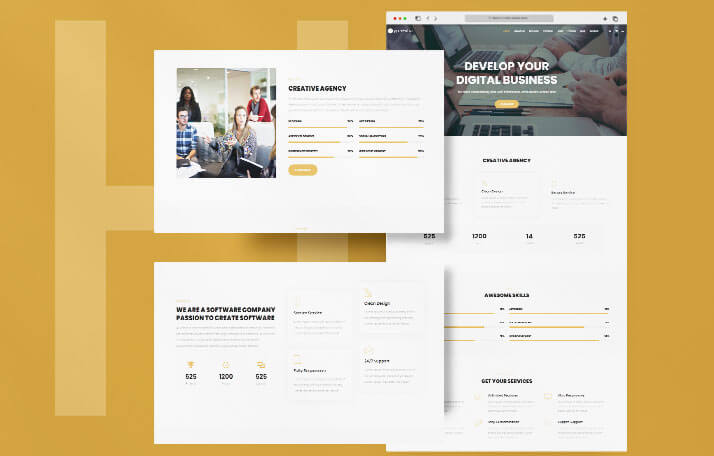
HyperExtra – Bootstrap 5.3 Agency Portfolio Template
HyperExtra is a Bootstrap 5.3 portfolio template with SCSS and jQuery, built for digital agencies, creative studios, startups, and freelancers who need a minimalist, one-page showcase site.
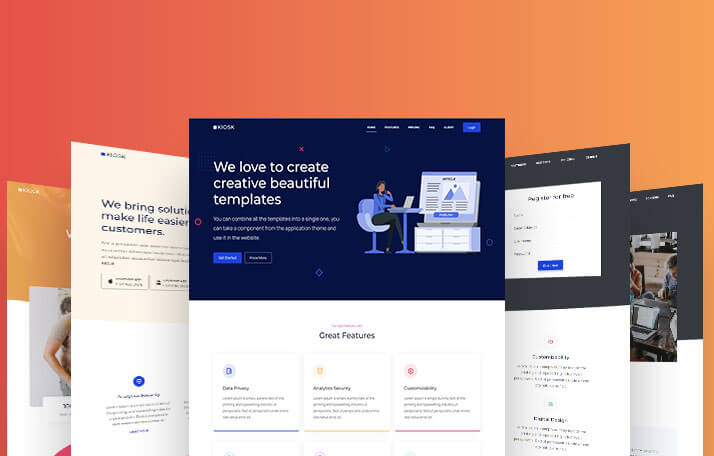
Kiosk – Multipurpose Bootstrap Landing Page Template
Kiosk packs 10+ ready-made page layouts into one Bootstrap 5.3.6 build — SCSS-powered and lightweight enough for a solo founder's landing page or a full agency portfolio site.
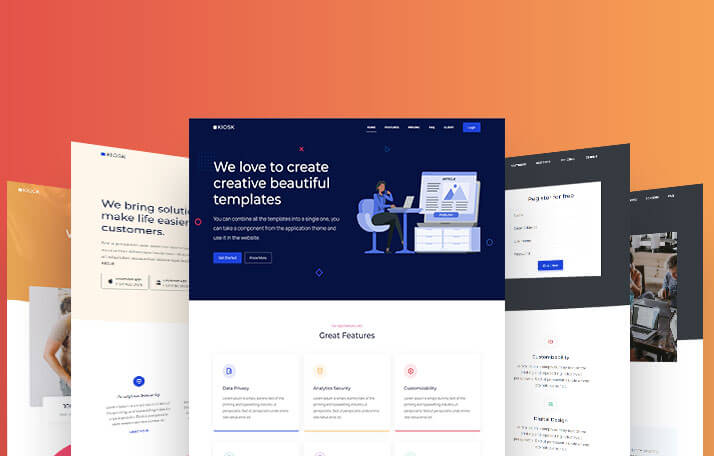
Kiosk – Angular Landing Page Template for SaaS & Agencies
Kiosk is a multipurpose Angular 20 template collection built with Bootstrap 5.3, SCSS, and TypeScript, offering 10+ page variants for startups, SaaS companies, agencies, and portfolios.

Dark – One-Page Responsive Bootstrap Portfolio Template
Dark is a single-page Bootstrap 4 website template built with SCSS and jQuery, offering a clean, minimalist dark theme ideal for personal websites, CVs, and creative portfolios alike.

Hoskon – HTML5 Bootstrap Hosting Website Template
Hoskon is a multi-page Bootstrap 5 hosting website theme built with SCSS and jQuery, offering 24+ pages for shared, VPS, dedicated, reseller, cloud, and WordPress hosting providers.

Dominac – Domain Sale Bootstrap 5 Landing Page Template
Dominac is a Bootstrap 5 domain-for-sale landing page template built with SCSS and jQuery, ideal for domain bidding, buying, selling, and offer-based domain marketplace websites today.
Use code FIRST30 at checkout — valid across every Bootstrap, Angular, and React
template.