
Marvel – Bootstrap Admin Dashboard Template for SaaS & CRM
Marvel is a Bootstrap 5.3 admin dashboard template with 135+ pages, 350+ components, and prebuilt Kanban, invoice, and eCommerce UI, built for SaaS, CRM, and analytics platforms alike.

See every module before you buy
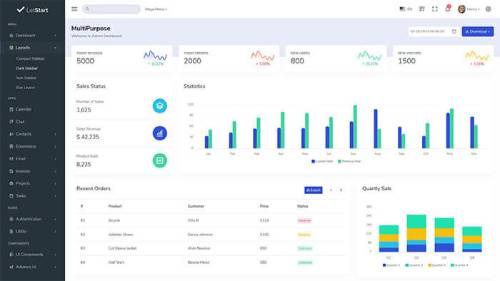
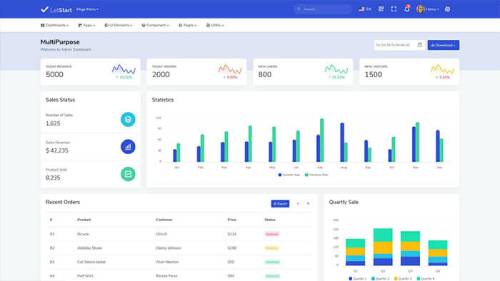
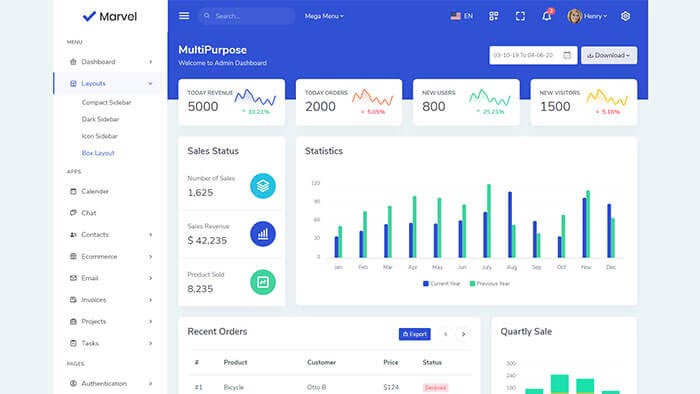
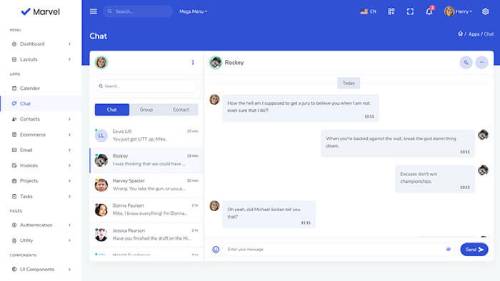
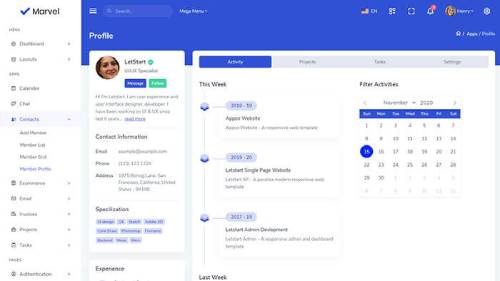
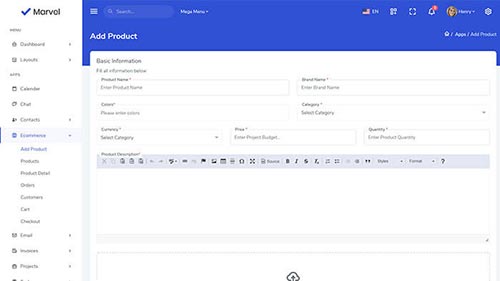
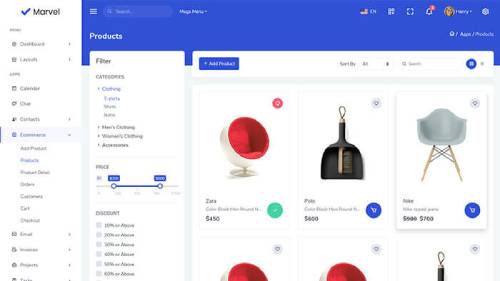
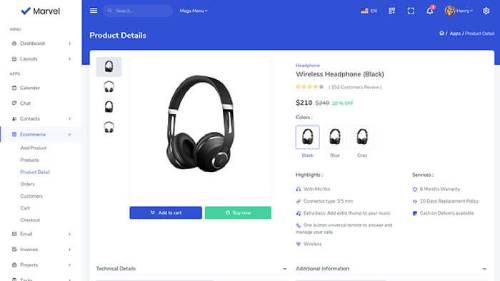
Each screenshot opens the full Marvel – Bootstrap Admin Dashboard Template for SaaS & CRM live preview, where you can browse the live preview and documentation.
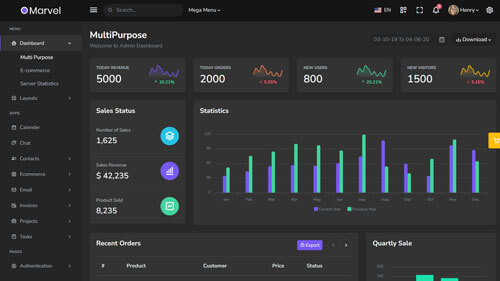
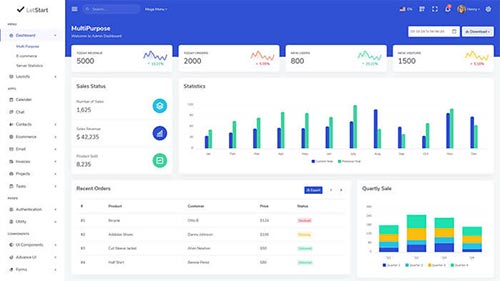


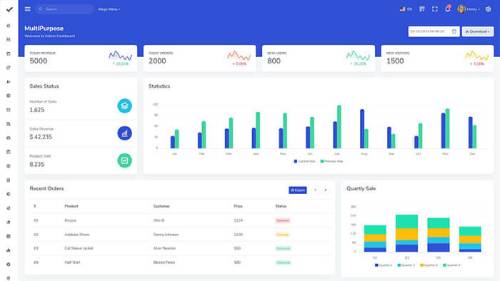
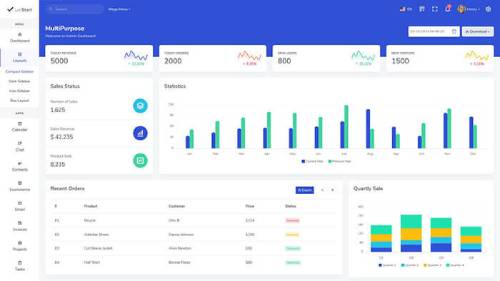
Overview
About Marvel
Most SaaS products, internal tools, and CRM platforms hit the same wall during development: the backend logic gets built quickly, but the admin interface that surfaces all of it — tables, charts, forms, task boards, invoices — takes far longer than anyone expects. Marvel – Multipurpose Bootstrap Admin Dashboard Template exists specifically to remove that bottleneck. Built on Bootstrap 5.3 with HTML, SCSS, and jQuery, Marvel is a genuinely comprehensive template designed for SaaS platforms, sales, marketing, analytics, CRM, e-commerce, web apps, and project management tools alike.
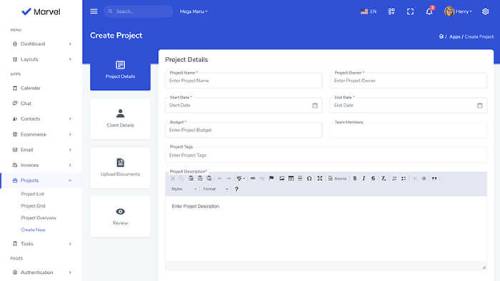
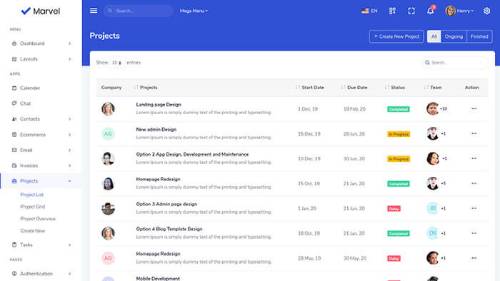
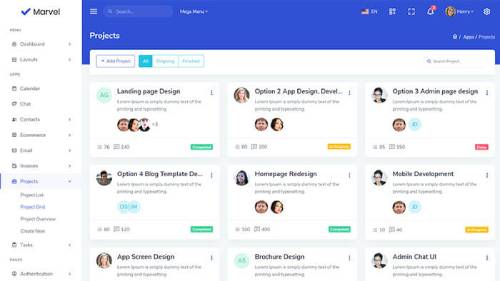
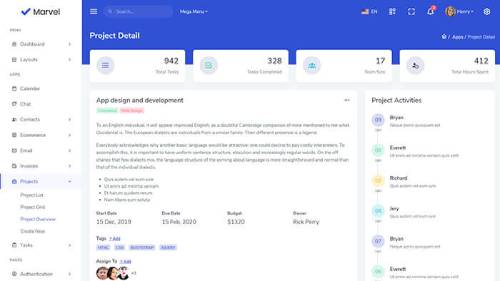
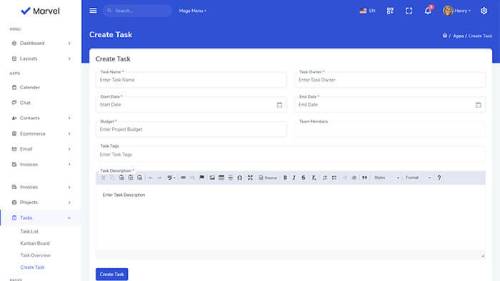
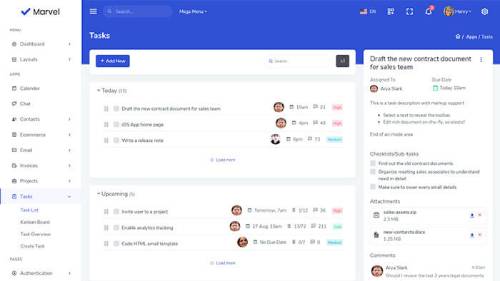
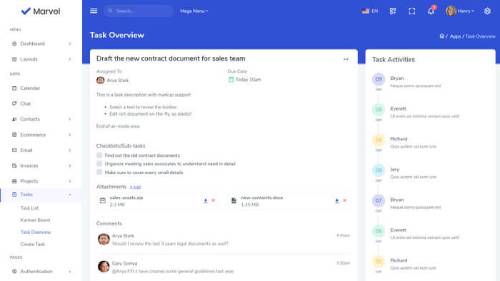
What separates Marvel from a typical admin template is sheer completeness. Rather than covering the basics and leaving teams to build the harder screens themselves, Marvel ships with 135+ pages and 350+ components spanning nearly every screen a real product actually needs on a day-to-day operational basis: project management with full create, manage, and delete workflows; task management with drag-and-drop Kanban boards; e-commerce UI for products, orders, and customers; invoice management; and a working email interface, all built on a consistent, modular design system.
Developers get a robust tech stack — HTML, SCSS, jQuery, and Bootstrap 5.3 — that keeps the codebase clean, modular, and maintainable, supporting Bootstrap admin templates, admin panels, and dashboard templates with interactive charts, tables, forms, and widgets, all built on Bootstrap's grid system and reusable UI components. This foundation ensures a consistent look and feel across every module in the dashboard, which matters when a product spans dozens of distinct screens built at different times by different developers with different individual styling instincts.
Marvel also comes with support for both horizontal and vertical dashboard layouts, along with condensed and fixed sidebar variations, giving teams the flexibility to match the dashboard's structure to how their own users actually navigate large applications. Some teams find a persistent vertical sidebar works best for deeply nested navigation with many modules; others prefer a horizontal top-nav approach that keeps more vertical screen space available for the actual content. Marvel supports both without requiring a separate template purchase or a substantial rebuild to switch between them.
Why Marvel Suits Complex, Growing Products
Smaller, more basic admin templates work fine for simple internal tools, but they start showing their limits fast once a product grows into something with real operational complexity — multiple user roles, invoicing, task tracking, e-commerce, and reporting all living under one roof. Marvel was built with that growth trajectory in mind from the start, rather than as a minimal starting point that teams inevitably outgrow within a few months of active development.
This matters especially for SaaS companies, where the admin dashboard often is the product, not just an internal tool sitting behind it. A CRM, a project management tool, an analytics reporting platform — these products' entire value proposition lives inside the dashboard experience, which means the quality and completeness of that dashboard directly determines customer retention and satisfaction. Marvel's breadth means teams building these kinds of products spend far less time reinventing standard UI patterns and far more time on the business logic and features that actually differentiate their product from competitors.
There's a specific failure mode Marvel is designed to avoid: the situation where a team picks a minimal admin template to move fast early on, only to discover six months later that half the dashboard needs a substantial rebuild because the original template simply didn't anticipate features like invoicing, Kanban-style task management, or e-commerce order tracking. That kind of mid-project rework is expensive in both engineering time and product momentum, and it's exactly the scenario Marvel's comprehensive scope is built to prevent by covering those modules from the first release rather than bolting them on awkwardly later.
Key Features of Marvel Bootstrap Admin Template
Multipurpose Dashboard Layouts
Marvel provides multiple prebuilt dashboard layouts, letting teams choose the structure best suited to their application, whether that's an analytics-focused view or a CMS-style content dashboard.
Responsive Design
The template is fully responsive, automatically adjusting layout, components, and charts to fit any screen size, ensuring a smooth experience for administrators working from mobile and tablet devices as well as desktops.
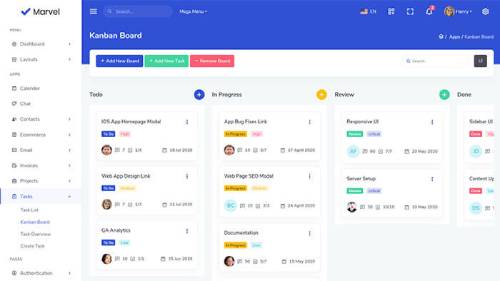
Kanban Task Board
A working Kanban board with drag-and-drop support lets teams organize and track tasks visually, a near-essential feature for any modern project management or team collaboration tool.
Email UI
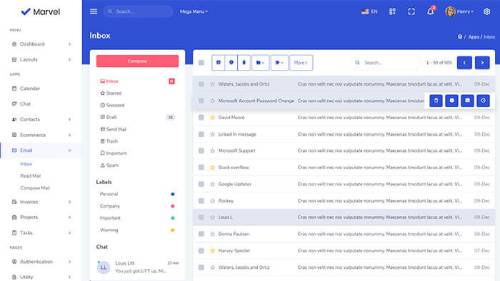
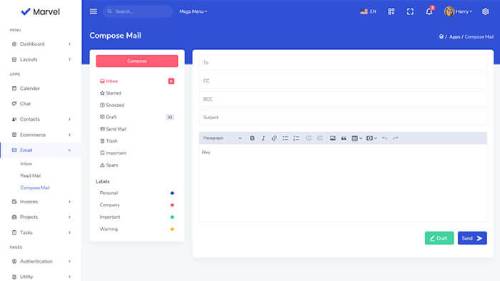
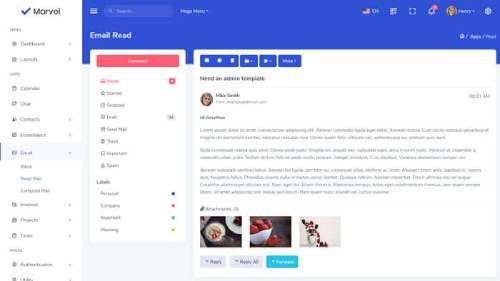
A built-in email interface supports managing an inbox, sending messages, and tracking correspondence directly within the dashboard, useful for CRM and support-focused applications.
Charts and Analytics
Interactive charts power data visualization throughout the dashboard, giving administrators the reporting tools needed to actually make sense of the data flowing through the application.
E-commerce Ready Pages
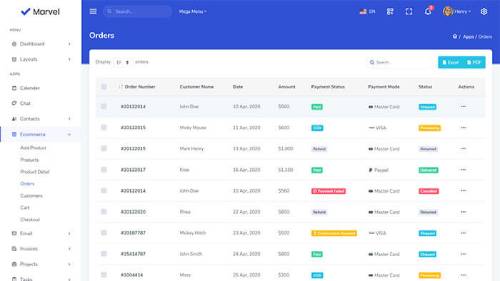
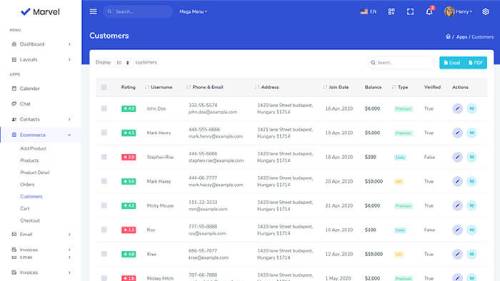
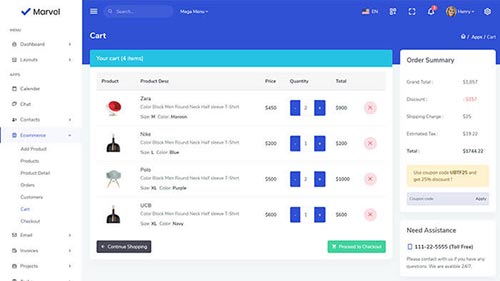
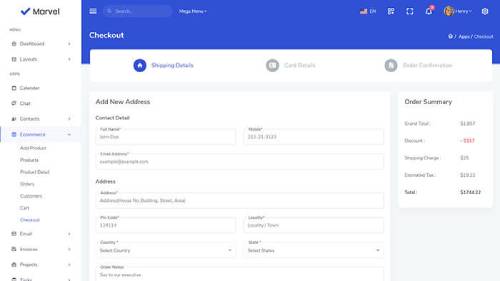
Prebuilt product list, detail, cart, checkout, customer, and order management pages give e-commerce admin panels a complete head start, covering the full purchase and fulfillment lifecycle.
Invoice Management
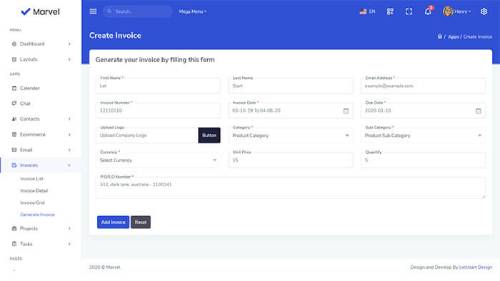
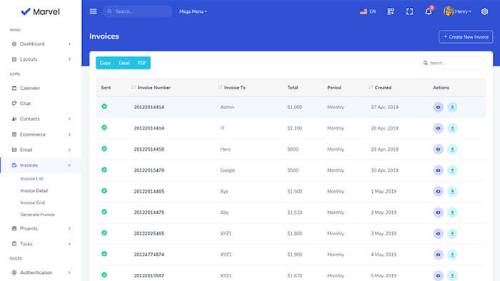
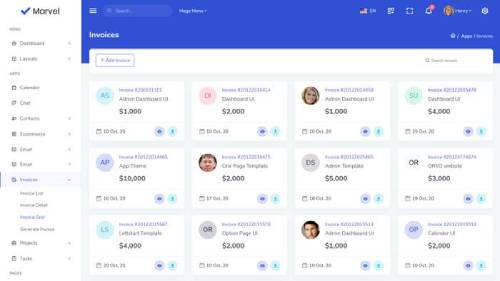
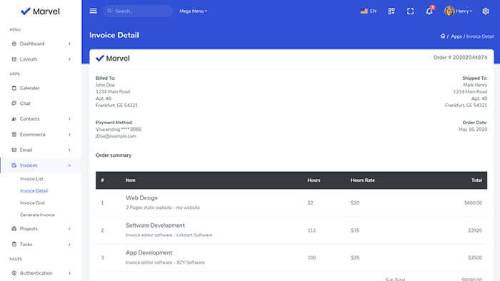
Create, view, and manage invoices through dedicated pages, streamlining billing and accounting workflows without requiring custom development for this common but often tedious requirement.
Contacts and Calendar Integration
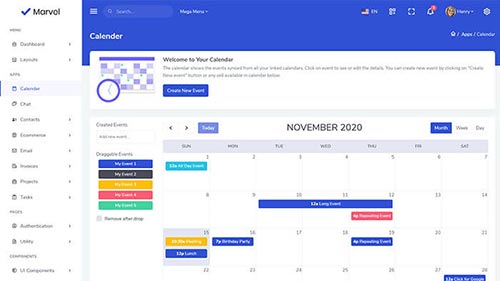
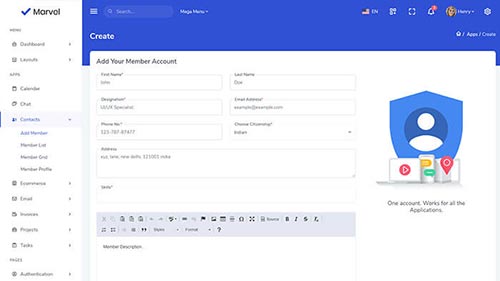
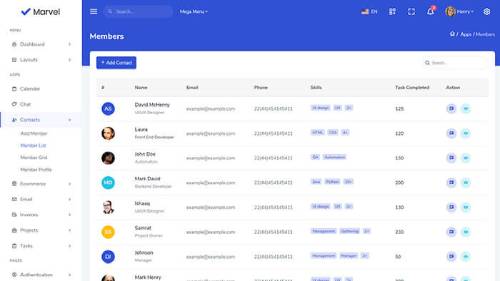
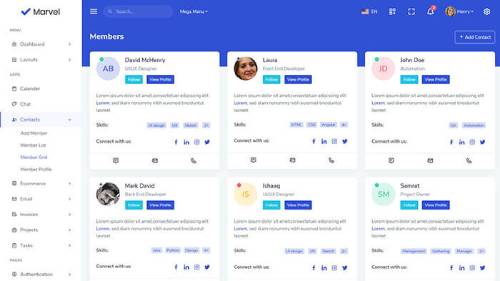
Manage contact lists and schedule tasks, meetings, and events directly within the dashboard, rounding out Marvel's coverage of the everyday operational screens a growing team relies on.
Dark and Light Sidebar Themes
Choose between dark and light sidebar variants, along with horizontal and vertical layout options, giving teams flexibility in how the overall dashboard experience is presented.
Developer-Friendly Tech Stack
Built with Bootstrap 5.3, HTML, SCSS, and jQuery, Marvel offers a modular and clean codebase that's straightforward to extend, add plugins to, or restructure as a product's requirements evolve.
Who Should Use Marvel
Marvel is built for teams shipping genuinely complex products: SaaS platforms with multiple user-facing modules, CRM systems tracking leads and customer relationships, e-commerce backends managing inventory and orders, and project management tools coordinating tasks across teams. Startups building their MVP benefit from Marvel's breadth by launching with a feature-complete admin experience from day one rather than a bare-bones version that needs constant expansion as customer requests come in, which is often exactly the kind of scope creep that slows down an early product roadmap when the underlying admin infrastructure isn't ready to absorb new requirements gracefully.
Agencies building custom internal or client-facing systems can use Marvel as a foundation that rarely runs short on a needed UI pattern, reducing the amount of custom component work required on any given engagement. This matters directly for project profitability — every hour spent building a generic table component or a standard settings page from scratch is an hour not spent on the client-specific business logic that actually justifies the engagement's cost, so a template with this much pre-existing coverage shifts the balance of billable hours meaningfully in the agency's favor.
And established products going through a redesign or admin panel overhaul can use Marvel's breadth to consolidate multiple previously bespoke tools — task tracking, invoicing, e-commerce management — into one consistent interface rather than maintaining several disconnected systems with different design languages, different codebases, and different maintenance burdens. That consolidation alone often justifies the migration effort, since supporting three or four separate internal tools with overlapping functionality tends to cost more in aggregate developer time than adopting one comprehensive dashboard template and building outward from there.
Handling Scale With Marvel's Component Library
The sheer size of Marvel's component library — 350+ components across 135+ pages — means teams rarely need to build a common UI pattern entirely from scratch. Need a settings page with tabbed sections? A user management table with role-based filtering and permissions? A billing history view with exportable records? There's a strong chance an existing Marvel page already covers most of that structure, meaning the actual development work becomes adapting an existing pattern to specific data rather than designing and building new UI from a blank canvas each time a new feature ships.
This compounding effect becomes more valuable the longer a product lives. Early-stage teams save time on initial launch; mature products save time on every subsequent feature addition, since new screens can borrow layout and component patterns from Marvel's existing library rather than requiring fresh design decisions for every incremental addition to the product. Over a multi-year product lifecycle, that accumulated time savings across dozens or hundreds of feature releases can dwarf the time saved during the initial build alone.
There's also a consistency benefit that compounds alongside the time savings. When every new screen in a growing product is built by pulling from the same underlying component library, the dashboard tends to stay visually and behaviorally coherent even as different developers work on different features over time. That coherence is genuinely difficult to maintain when every developer is building UI from scratch according to their own instincts, and it's one of the quieter but more persistent advantages of standardizing on a comprehensive template like Marvel from the start.
Conclusion
The Marvel Bootstrap Admin Dashboard Template for SaaS, E-commerce, Sales, Marketing, and Analytics is a robust, fully responsive, and multipurpose solution for developers, startups, and enterprises. Combining the power of Bootstrap 5.3, modular UI components, and responsive design, it delivers functional and visually appealing dashboards that reduce development time while maintaining a modern, professional look across every module.
Whether managing projects, tracking analytics, handling invoices, or running a full SaaS platform, Marvel is built to cover the breadth of admin dashboard needs a growing product will actually encounter, rather than the narrow slice most templates settle for. For teams that have already felt the pain of outgrowing a smaller template mid-project, that breadth isn't a nice-to-have — it's the entire reason to choose a comprehensive foundation from the start rather than paying for that decision later in the form of a disruptive, unplanned rebuild.
Related templates
The modules, laid out like the product itself
All 12 highlights, grouped the way they appear in Marvel – Bootstrap Admin Dashboard Template for SaaS & CRM's own sidebar.
135+ Pages
350+ Components
End-to-End Front End Solution
Kanban Board with Drag & Drop
Email UI
Invoice Management UI
E-commerce Product, Cart & Order UI
Form Validation & UI Submission
Dark and Light Sidebar Themes
Horizontal and Vertical Layouts
Easy to Customize Components
Interactive Charts and Data Tables
What buyers are saying
It's an amazing product. I love it. The product has much more than I expected.
Good documentation and best code quality.
Great support, Easy to customize code.
Before you get started
Marvel is a responsive Bootstrap Admin Dashboard Template built with Bootstrap 5.3, HTML, SCSS, and jQuery, designed for SaaS, E-commerce, CRM, Analytics, and Web Apps.
Yes. Marvel provides prebuilt components, charts, tables, and forms, making it ideal for SaaS applications and E-commerce admin dashboards.
Absolutely. With a modular codebase, SCSS, and reusable Bootstrap UI components, developers can easily customize layouts, add plugins, and extend functionality.
Yes. Marvel is fully responsive, ensuring seamless performance across desktops, tablets, and mobile devices.
The template includes prebuilt Kanban task boards, email UI, project lists, charts, tables, forms, calendar, chat, contact management, and E-commerce pages.
Developers, startups, SaaS platforms, marketing teams, and E-commerce businesses can use Marvel to create modern, responsive, and feature-rich admin dashboards quickly.
Change log
- bug fixing
- bug fixing
- Remove library which doesn't support Bootstrap 5
- Updated to Bootstrap 5.3
Marvel – Bootstrap Admin Dashboard Template for SaaS & CRM in other frameworks
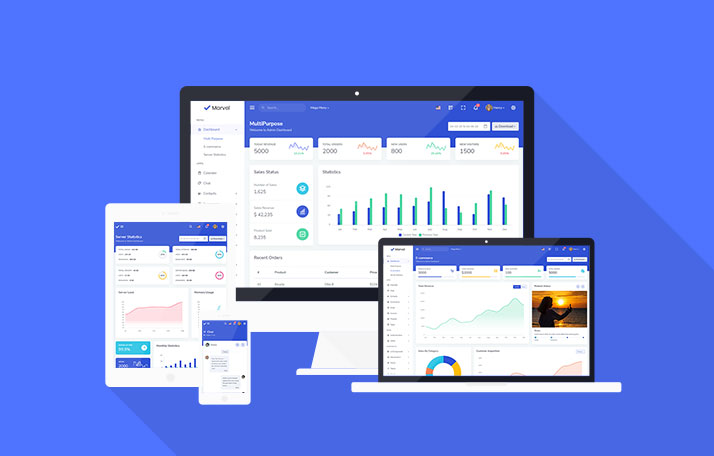
Marvel – Angular Admin Dashboard Template for SaaS & CRM
Marvel is an Angular 21 admin dashboard template with 120+ pages, 350+ components, and prebuilt Kanban, invoice, and eCommerce UI, built for SaaS, CRM, and analytics platforms alike.

Marvel – Free Bootstrap 4 Admin Dashboard & UI Kit
Marvel Free is a free, responsive Bootstrap admin dashboard template built with HTML, SCSS, and jQuery, ideal for kickstarting a new project without any upfront licensing cost at all.
Related templates

Letstart – Minimal Bootstrap 5 Admin Dashboard Template
Letstart is a minimal, modern Bootstrap 5.3 admin dashboard template with 70+ pages and 100+ components, built with Sass and jQuery for eCommerce panels and HTML back-end dashboards.
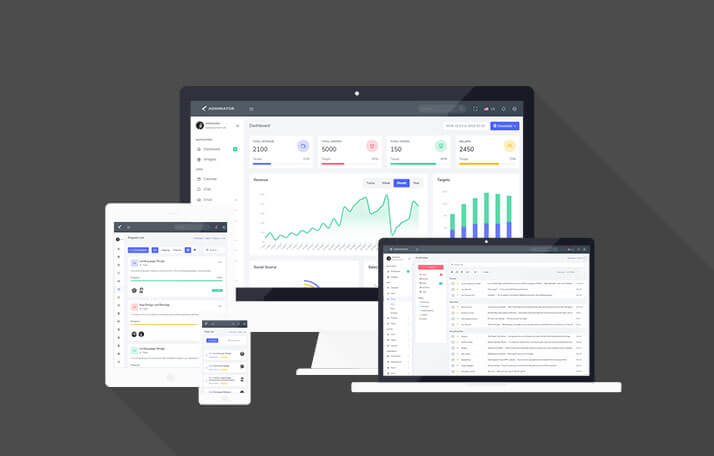
Adminox – Angular 22 Admin Dashboard with 70+ Components
Adminox is a modern Angular 22 admin dashboard starter with 40+ pages, 6 layouts, 3 chart libraries, JWT auth, and NgRx Signals, ready for SaaS, CRM, and analytics projects from day one.
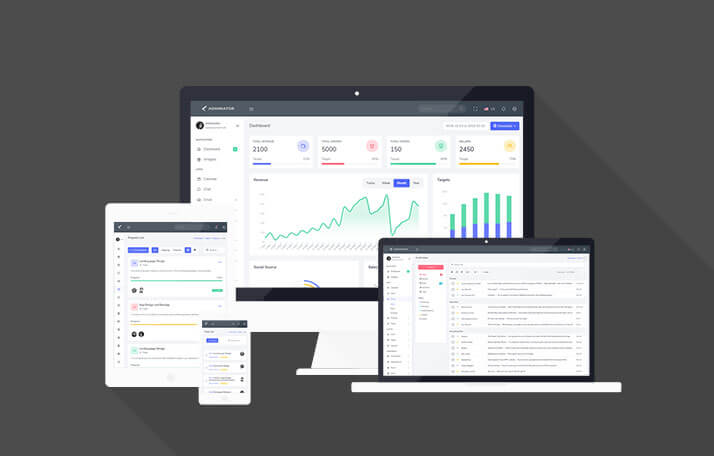
Adminator – Bootstrap 5 Admin Dashboard & Panel Template
Adminator is a clean, modern Bootstrap 5 admin dashboard template built with SCSS and jQuery, ideal for eCommerce panels, analytics dashboards, and project management admin panels.

Proctu – Hospital & Medical Bootstrap Admin Template
Proctu is a Bootstrap framework-based admin dashboard panel built for patient and hospital dashboards, doctor medical admin panels, and general healthcare HTML dashboard applications.

APIC – Bootstrap Admin Dashboard for SaaS & Analytics
APIC is a responsive, creative, and modular Bootstrap admin dashboard template, ideal for sales and analytics dashboards, management panels, and general SaaS-based admin interfaces.
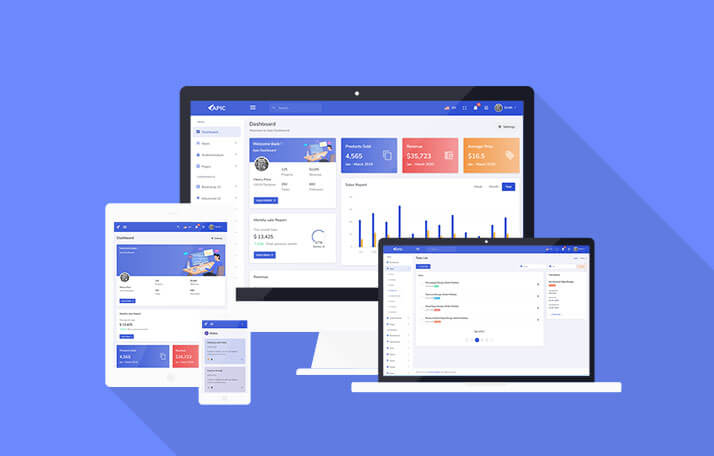
APIC – Angular 22 Admin Dashboard Template for SaaS & CRM
APIC is a multipurpose, creative, and modular Angular 22 admin dashboard template, ideal for sales and analytics dashboards, management panels, and SaaS-based admin interfaces overall.
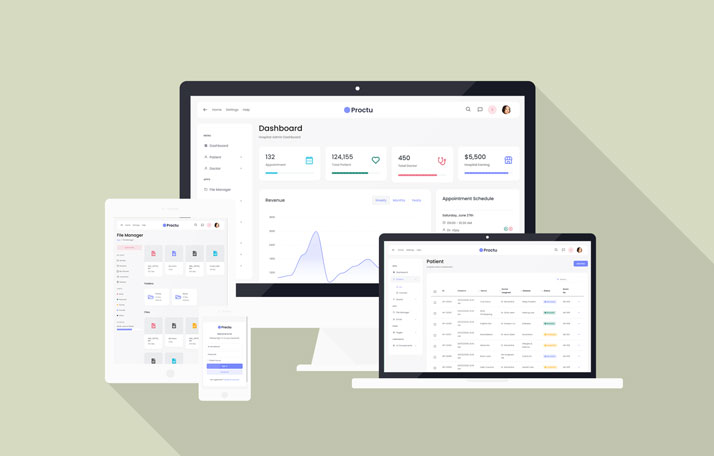
Proctu – Hospital & Medical React Next.js Admin Template
Proctu is a React Next.js framework-based admin dashboard built for patient and hospital dashboards, doctor medical admin panels, and general healthcare React dashboard applications.
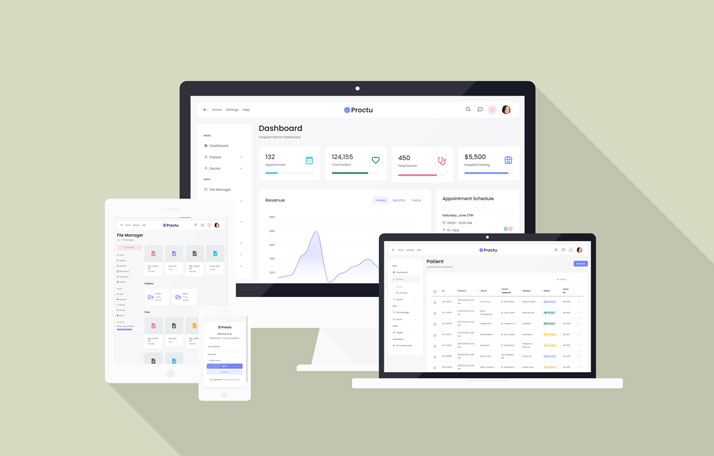
Proctu – Hospital & Medical Angular Admin Template
Proctu is a Bootstrap and Angular 22 admin dashboard panel built for patient and hospital dashboards, doctor medical admin panels, and general healthcare Angular applications today.
Use code FIRST30 at checkout — valid across every Bootstrap, Angular, and React
template.