
I have been building with Bootstrap since version 3 in 2013. Every template on LettStartDesign is built on Bootstrap — Angular, React, Next.js, all of them. I also have a Tailwind template in development right now. So when I compare these two frameworks, I am not a Bootstrap loyalist dismissing Tailwind. I am someone who has worked deeply in Bootstrap and is actively building in Tailwind. That context matters for reading this comparison.
Where I'm coming from: Something interesting happens when you look at what customers actually buy. At LettStartDesign, the most common purchases are Angular and Next.js templates — and most buyers are not asking whether those templates use Bootstrap or Tailwind. They are asking whether the template is clean, well-structured, and production-ready. The CSS framework underneath is often secondary to the overall quality.
That observation does not mean the Bootstrap vs Tailwind decision does not matter. It means the decision is more nuanced than most comparison posts suggest. This one tries to give you the honest version.
What Each Framework Actually Solves
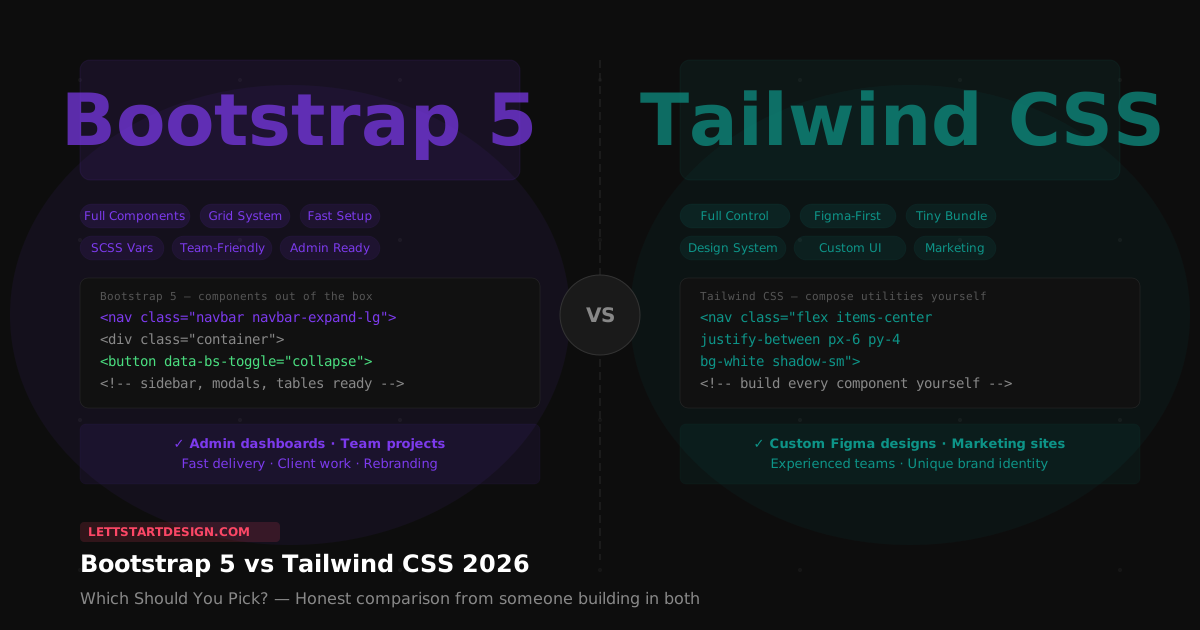
Bootstrap 5 is a complete UI framework. It ships with a responsive grid system, a full component library — navigation, modals, dropdowns, tabs, accordions, forms, tables, badges, progress bars, cards — JavaScript behaviours, and utility classes. You have everything you need to build a working interface before writing a single line of custom CSS.
Tailwind CSS is a utility-first framework. It gives you low-level utility classes — spacing, colour, typography, flexbox, grid — and you compose those utilities into components yourself. The components do not exist until you build them. This is a deliberate design decision and it is genuinely powerful when you have a specific design to implement. It is significantly more work when you do not.
The core difference is not about which framework is better. It is about what you are optimising for. Bootstrap optimises for speed to a working interface. Tailwind optimises for design control and pixel-level precision. Both are legitimate goals — they just suit different projects.
Where Bootstrap 5 Wins
Bootstrap's component coverage is the clearest advantage for most projects. Every item below is production-ready, accessible, responsive, and available immediately:
With Tailwind, every item above is something you build yourself or source from a separate component library. Those libraries — Headless UI, Radix, shadcn/ui — are good. But they add dependencies, require configuration, and each has its own API. Bootstrap ships all of this in one package with one consistent design language.
Bootstrap's SCSS variable system is also a genuine advantage for client work. Change the primary colour, border
radius, and font family in a single _variables.scss file and the entire component library updates. For
agencies delivering branded templates to clients, that workflow is fast and reliable.
Where Tailwind CSS Wins
Tailwind's strength is design freedom — and in the right context, that freedom is genuinely valuable. When you are building from a detailed Figma design where every page needs a unique look, Bootstrap's component aesthetics can feel like constraints. Tailwind gives you full control over every pixel without fighting an existing design system.
Tailwind's bundle size advantage is also real. Because it only includes the utility classes you actually use, the final CSS is typically much smaller than a full Bootstrap build. For projects where page load speed is critical — marketing sites, SEO-focused content, high-traffic landing pages — that difference matters.
The Tailwind ecosystem has also matured significantly. Component libraries like shadcn/ui have made it easier to get working components without building everything from scratch. The argument that Tailwind requires you to build all components manually is less true in 2026 than it was two years ago — though the investment in setting up that ecosystem is still real.
Our customers mostly buy Angular and Next.js templates — and most of them are not asking whether we used Bootstrap or Tailwind. They are asking whether the code is clean, whether the architecture is sensible, and whether it will save them time. The CSS framework underneath matters less than the overall quality of the implementation. I think that is the right way to evaluate any template.
Head-to-Head Comparison
| Factor | Bootstrap 5 | Tailwind CSS | Winner |
|---|---|---|---|
| Components out of the box | Full library — nav, modals, forms, tables | Utilities only — build components yourself | Bootstrap |
| Speed to working interface | Fast — components ready immediately | Slower — setup and build time required | Bootstrap |
| Custom design from Figma | Good — SCSS overrides | Excellent — full utility control | Tailwind |
| Team onboarding speed | Fast — most developers know Bootstrap | Requires Tailwind knowledge and conventions | Bootstrap |
| CSS bundle size | Larger base — tree shaking helps | Smaller — only used utilities included | Tailwind |
| Theming and rebranding | Single SCSS variables file | tailwind.config.js — more setup | Bootstrap |
| Admin dashboard development | Excellent — components match dashboard needs | Good — with a component library | Bootstrap |
| Marketing and landing pages | Good | Excellent — more visual freedom | Tailwind |
| Long-term maintainability | Excellent — semantic, stable API | Good — requires consistent conventions | Bootstrap |
| Template and ecosystem availability | Extensive — mature ecosystem | Growing — more options every year | Bootstrap |
✅ Bootstrap 5 Is Better For
- Admin dashboards and data-heavy apps
- Teams with mixed frontend experience
- Projects needing fast delivery
- Client work with rebranding requirements
- Long-term maintained enterprise apps
- Anyone starting from a template
✅ Tailwind Is Better For
- Custom Figma-driven UI designs
- Experienced frontend teams with conventions
- Marketing and brand-heavy websites
- Long-term bespoke design systems
- Projects where bundle size is critical
What Real Buyers Actually Care About
After building and selling templates since 2021, the pattern is clear — buyers rarely lead with "is this Bootstrap or Tailwind?" They lead with "is this Angular or React?", "how many pages does it have?", and "what does the code look like?" The CSS framework is usually confirmed after the decision is already made, not before it.
What this tells me is that the Bootstrap vs Tailwind debate, while real for developers making technical architecture decisions, is secondary to overall code quality and framework fit for most template buyers. A poorly structured Tailwind template is worse than a well-structured Bootstrap template, and vice versa. The framework underneath matters less than the quality of the implementation on top of it.
That said — when developers are building from scratch and choosing a stack deliberately, the decision matters. The sections below give you the direct answer for that context.
When to Pick Bootstrap 5
Pick Bootstrap 5 when your project involves an admin dashboard, a data-heavy application, or anything where you need 20+ working UI components quickly. Pick it when your team already knows Bootstrap and you want zero ramp-up time. Pick it when you are building for clients who need to maintain the project themselves — Bootstrap's semantic class names make it significantly easier for non-specialist developers to understand and modify the codebase.
Pick Bootstrap 5 when you are starting from a template. Every Bootstrap template on LettStartDesign is built with a consistent SCSS variable system — change the primary colour and font once, and the entire template updates. That workflow is fast, reliable, and easy to hand off.
When to Pick Tailwind CSS
Pick Tailwind when you are building a custom UI from a detailed Figma design where every page needs a unique visual treatment and there is no existing design system to match. In that context, Bootstrap's component aesthetics become constraints rather than conveniences. Tailwind gives you the utility-level control to implement any design precisely.
Pick Tailwind when you have an experienced frontend team that will enforce consistent utility class conventions — either through a design system, a component library, or strong code review culture. Without that discipline, Tailwind codebases develop inconsistency problems quickly. With it, Tailwind produces some of the cleanest, most maintainable CSS I have seen.
We have a Tailwind template in development at LettStartDesign. It is coming because there is a genuine use case for it — not because Tailwind is universally better. It will sit alongside our Bootstrap templates, not replace them.
Bootstrap 5 Templates on LettStartDesign
Porto — Multipurpose Bootstrap 5 Website Template
Our most consistently recommended template across developer communities — not because we push it, but because developers recommend it to each other. Multi-page, multi-purpose: startup, corporate, portfolio, agency, eCommerce. Bootstrap 5.2 with a full SCSS variable system that makes client rebranding genuinely fast.
- Bootstrap 5.2 — complete component coverage throughout
- Multi-purpose — startup, agency, corporate, portfolio, eCommerce layouts
- Full SCSS variable system — rebrand in one file
- Fully responsive across all Bootstrap breakpoints
Marvel Angular — Angular 21 + Bootstrap 5 Admin Dashboard
The template that best demonstrates what Bootstrap 5 delivers for admin dashboard development — 120+ pages, 350+ components, 7 dashboard layouts, and every Bootstrap component you need pre-configured. No assembly required.
- Angular 21 with Signals, standalone components, modern control flow
- Bootstrap 5.3 — complete admin component library throughout
- 120+ pages covering SaaS, CRM, eCommerce, analytics
- ApexCharts and ECharts — 50+ chart types pre-configured
- Full SCSS variable system — rebrand in one file
Final Thoughts
Bootstrap 5 and Tailwind CSS solve different problems. Bootstrap optimises for component coverage and development speed. Tailwind optimises for design freedom and utility-level precision. Neither is unconditionally better — the right choice depends on what you are building, who is building it, and what matters most for that specific project.
For admin dashboards, data-heavy applications, and team projects where speed to a working interface matters — Bootstrap 5 is still the more practical choice in 2026. For custom Figma-driven designs where visual precision is the priority and you have the team to enforce consistent Tailwind conventions — Tailwind is worth it.
Most of our customers choose Angular or Next.js first, then discover which CSS framework suits their workflow. If you are in that position, start with Bootstrap. It is the faster path to a working product, and you can always move toward more customised styling as the project matures. Browse the full Bootstrap templates collection or reach out if you need a direct recommendation.