
Forma – Astro Portfolio Template for Agency & Studio
Forma is an Astro portfolio template and Astro agency website template with no React runtime, a Digital Violet design system, five home page variants, and a case study portfolio template built in.
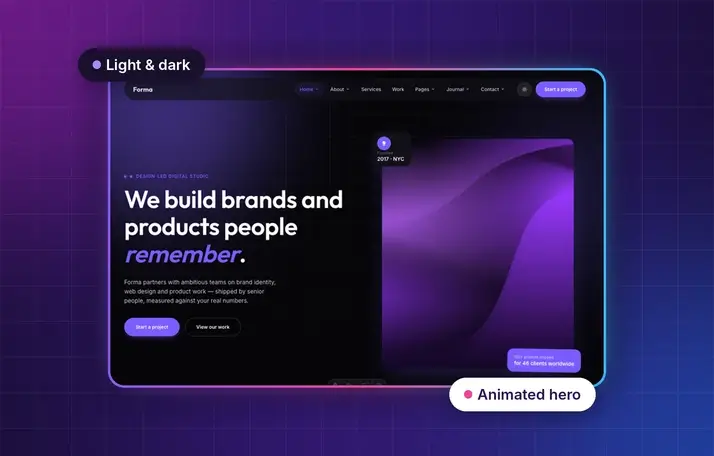
See every module before you buy
Each screenshot opens the full Forma – Astro Portfolio Template for Agency & Studio live preview, where you can browse the live preview and documentation.






Overview
- About Forma
- Why Choose Forma for an Agency Site
- Key Features of Forma
- Five Homepages, One Shared System
- Type and Rhythm, Not Just Color
- Case Studies, Not Just a Gallery
- Imagery That Works Out of the Box
- Inter and Outfit, Self-hosted
- Boxicons for Every Interface Icon
- Who Should Use Forma
- Specifications and Support
- Conclusion
- Related templates
About Forma
Creative and digital agencies sell on the strength of their own site before a prospect ever looks at their portfolio. Forma — Astro Agency & Studio Landing Page Template is a ground-up build for agencies and studios that need a portfolio-led marketing site with real visual identity, not a generic business template with a different logo dropped in.
Built with Astro 7 and Tailwind CSS 4 — with no React, Vue or other UI framework in the project — Forma introduces its own "Digital Violet" color system: a deep indigo/violet accent on near-black surfaces, implemented as --forma-* custom properties in src/styles/tokens.css, in the direction favored by premium creative and tech studios. Full dark/light theme support ships through a toggle, and three alternative palette directions are documented for teams who want a different identity without redesigning the layout from scratch. The small amount of motion on the page — section reveals, hover states — is handled by the lightweight motion library running as plain JavaScript, not a React animation layer.
Why Choose Forma for an Agency Site
Forma ships five distinct homepage variants — modern, classic, corporate, creative and video-led — built from the same underlying section library, so an agency can pick the tone that matches its positioning without starting the build over. A boutique creative studio and a more buttoned-up digital agency can both launch from Forma and end up with sites that read as genuinely different in personality, despite sharing the same component code underneath.
The portfolio section includes both a filterable index and individual case study detail pages, giving real project work a proper showcase — process, outcomes, visuals — rather than a flat image grid that forces every project into the same shallow format. Every image in the template, from portfolio covers to team photos to testimonial avatars, loads live from Unsplash by default via query-parameter cropping, so the project runs immediately with zero binary assets committed to the repository; a dedicated IMAGE-ASSETS.md guide documents the exact photo IDs and dimensions to download and swap in before launch.
Key Features of Forma
Five Homepage Variants
Modern, classic, corporate, creative and video-led homepages are all included, sharing the same component and data layer so switching the default experience is a matter of routing to a different variant, not rebuilding a page from zero.
Portfolio with Case Studies
A filterable portfolio index links through to individual case study pages, each with its own content slots for process, outcomes and supporting visuals, letting an agency present finished work with real narrative instead of a caption under a thumbnail.
Digital Violet Design System
A deep indigo/violet-on-near-black token system, implemented as --forma-* custom properties with full light-mode overrides, is designed to read as current and premium rather than reaching for the same blue-and-white palette most business templates default to.
Journal, Contact and Legal Pages
A blog-style journal with an index, a sidebar variant and individual post pages gives an agency a place to publish thinking and case-adjacent writing, a contact page (plus a maps variant) ships with a working PHP-backed form, and a privacy page rounds out the site alongside dedicated About, About Agency and Services pages.
Services and About Pages Built for Agencies
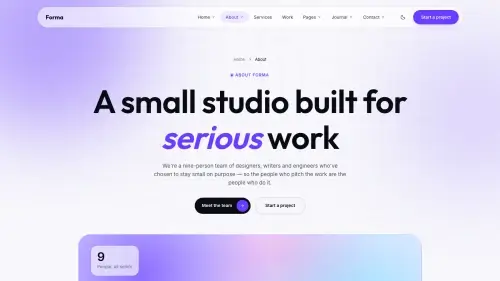
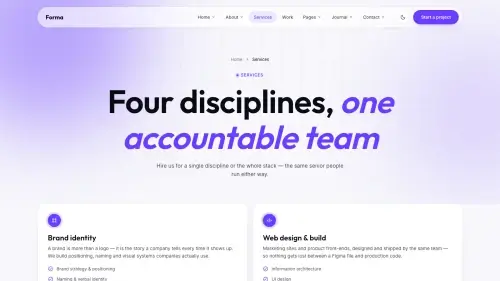
The Services page is structured around how agencies actually sell — service categories, process, and outcomes — rather than a generic feature list, and the About and About Agency pages give room for team, values and studio story in a layout that matches the rest of Forma's visual identity.
No Framework, Plain Astro Throughout
Every section — hero, portfolio filter, testimonial banner, process steps — is a native .astro component with the motion library handling reveal and hover animation in plain JavaScript, so there is no client-side framework runtime to hydrate or ship to the browser.
Five Homepages, One Shared System
The temptation with a multi-variant template is to let each homepage drift into its own one-off markup, so that fixing a bug in the hero on one variant doesn't fix it anywhere else. Forma avoids that by keeping all five variants — modern, classic, corporate, creative and video — built from the same section components and the same src/data/*.ts content files, with each variant choosing a different arrangement, density and visual treatment of those shared pieces rather than maintaining five separate component trees. That means a content change (a new testimonial, an updated stat) shows up correctly across whichever variants use that section, and a visual fix only needs to be made once.
Choosing a default variant for a live deployment is a matter of pointing the site's index route at the desired variant file; the other four stay in the project as alternate entry points a team can link to, A/B test, or hand to different stakeholders (sales wanting the corporate tone, marketing wanting the creative one) without maintaining four separate repositories.
Type and Rhythm, Not Just Color
Forma's identity isn't limited to its violet accent: Inter and Outfit are paired for body copy and display headings respectively, with a consistent vertical rhythm carried across every section so that switching between the five homepage variants never feels like switching between five unrelated designs. That typographic discipline is what keeps the five-variant promise credible — the variants genuinely read as different tones of the same studio, not five disconnected templates stapled together under one name.
Case Studies, Not Just a Gallery
Portfolio sections on agency templates often stop at a grid of images that link to a lightbox. Forma's portfolio detail pages are structured content instead — a project brief, the process the studio followed, the outcome, and a supporting gallery — so an agency can actually tell the story of a project rather than relying on the image alone to carry it. Because the detail page layout is shared across every case study, adding a new project means filling in a new data entry rather than designing a new page.
Imagery That Works Out of the Box
Every photo in Forma — portfolio covers, team headshots, testimonial avatars — is a live Unsplash URL with crop and size parameters baked in, sourced from a documented list of photo IDs in IMAGE-ASSETS.md. That means a fresh checkout of the project renders a fully populated, realistic-looking site immediately, with no broken image icons and no placeholder gray boxes, while still making it straightforward to swap in a studio's real photography before launch by downloading the listed photos and updating the paths in the matching data file.
Inter and Outfit, Self-hosted
Both typefaces are shipped as self-hosted Fontsource packages rather than loaded from a third-party font CDN, so the page has one fewer external request to wait on and no third-party font service to depend on staying available, which matters for a template that's explicitly optimizing for a fast first paint across its five homepage variants.
Boxicons for Every Interface Icon
Navigation affordances, service icons and social links all draw from Boxicons rather than a mix of inline SVGs sourced from different places, keeping icon weight and style consistent across all five homepage variants and every secondary page in the site.
Who Should Use Forma
Forma is built for design agencies, creative studios and freelance studios that need a portfolio-forward site with a distinct visual identity, multiple homepage directions to choose from depending on positioning, and a proper case-study format for showcasing client work in real depth rather than a single hero image per project. It's just as useful for a studio that works across several kinds of clients — corporate, creative, video production — and wants one codebase that can present each relationship with a matching homepage variant instead of forcing every pitch through the same visual tone.
Because there's no React runtime anywhere in the project, Forma also suits agencies whose own delivery standard favors plain HTML/CSS/JS output for client handoffs, or who've been asked by a client's IT team to avoid a heavier JavaScript dependency on a site that's fundamentally just marketing content. How much that matters depends partly on how committed a studio is to the Digital Violet identity itself: it's deliberately not a neutral palette a client could mistake for any other agency's site, so teams wanting that distinctiveness get more out of it than teams who'd rather build their own identity from a blanker base. Worth knowing going in, too, that Forma's content lives in TypeScript data files a developer edits directly rather than through any admin interface — a fair trade for the typed safety it buys, but not a fit for a site a non-technical team member needs to update themselves.
As an Astro portfolio template specifically, not a general entry among Astro website templates with a portfolio page bolted on as an afterthought, its case-study format is the real differentiator to check when weighing it against the best Astro templates for showcasing client work.
Forma is part of LettStart Design's Astro themes, Astro templates, Astro website templates and best Astro templates collection. It also belongs in the Astro portfolio template, landing page template, portfolio website template, portfolio template and personal portfolio website template categories, so you can compare it with similar templates in the same range.
Specifications and Support
Forma is made by LettStart Design, and the details below come straight from the template package. It is built with Astro 7.4, Tailwind CSS 4.3 and TypeScript. Documentation is available before you buy.
- 5 Homepage Variants
- Portfolio: Index + Case Studies
- Journal: Blog Index + Posts
- Theme: Digital Violet, Dark/Light
- Tech Used: Astro 7, Tailwind CSS 4
- Forms: PHP-backed Contact Form
- Imagery: Live Unsplash by Default
- Motion: motion Library, No React
Forma is an Astro agency website template with an Astro portfolio template at its core. Its case study layouts make it a case study portfolio template, and as an Astro landing page template it offers five home page variants for studios and agencies.
Conclusion
Forma gives agencies and studios a modern, portfolio-led marketing site with real visual personality — five homepage directions, a case-study-ready portfolio, and a content system for journal posts — built entirely on native Astro components with no client-side framework overhead.
Related templates
The modules, laid out like the product itself
All 10 highlights, grouped the way they appear in Forma – Astro Portfolio Template for Agency & Studio's own sidebar.
Five Homepage Variants: Modern, Classic, Corporate, Creative, Video
Portfolio Index with Filtering + Case Study Detail Pages
Digital Violet Design System with Dark/Light Toggle
Journal (Blog) with Index, Sidebar Variant and Post Pages
Contact Pages with Working PHP-backed Form
About, About Agency, Services and Privacy Pages
Motion Library for Reveal/Hover Animation (No React)
Three Alternative Color Palette Directions Documented
Zero Binary Assets by Default (Live Unsplash Imagery)
Astro 7 + Tailwind CSS 4, No Client-side Framework
What buyers are saying
No reviews yet — be the first to share your experience.
Before you get started
Forma is an Astro portfolio template for creative and digital agencies, with case studies, a journal, and its own Digital Violet design system, built among Astro website templates to focus specifically on client work.
Yes, Forma ships five homepage variants (modern, classic, corporate, creative and video) built from the same component library.
No. Forma has no React dependency; its motion and animation are handled by the lightweight motion library running as plain JavaScript inside native Astro components.
Forma runs out of the box with live Unsplash imagery and includes an IMAGE-ASSETS.md guide listing every photo ID and dimension to download and replace before launch.
Yes, Forma includes a full dark/light theme toggle built on its Digital Violet token system.
Yes. Forma is built as an agency case study template and case study portfolio template, with each project page structured around a brief, process, outcome and gallery rather than a flat grid of images.
Forma belongs to LettStart Design's Astro themes, Astro templates, Astro website templates and best Astro templates collection and is also suited to Astro portfolio template, landing page template, portfolio website template, portfolio template and personal portfolio website template use cases.
Change log
- Initial release
- Astro 7, Tailwind CSS 4, zero client-side framework
- Digital Violet design system with dark/light toggle
- Five homepage variants, portfolio with case studies, journal
Related templates
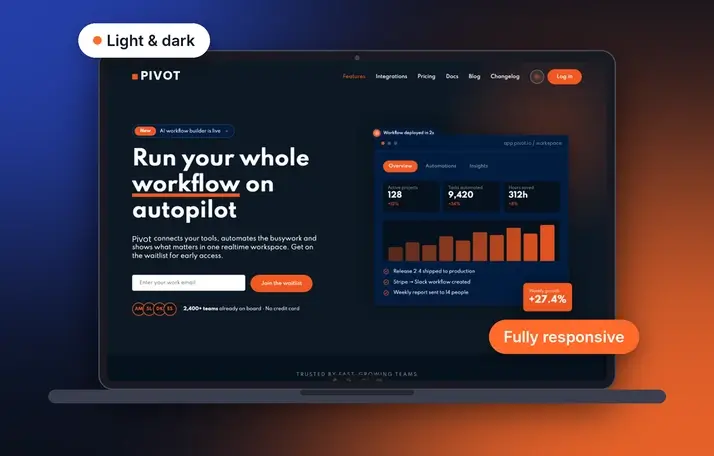
Pivot – Astro SaaS Template & Startup Landing Page
Pivot is an Astro SaaS template and SaaS landing page Astro template with no React runtime, a dark mode SaaS landing page theme, docs, changelog, and PHP-backed waitlist forms.
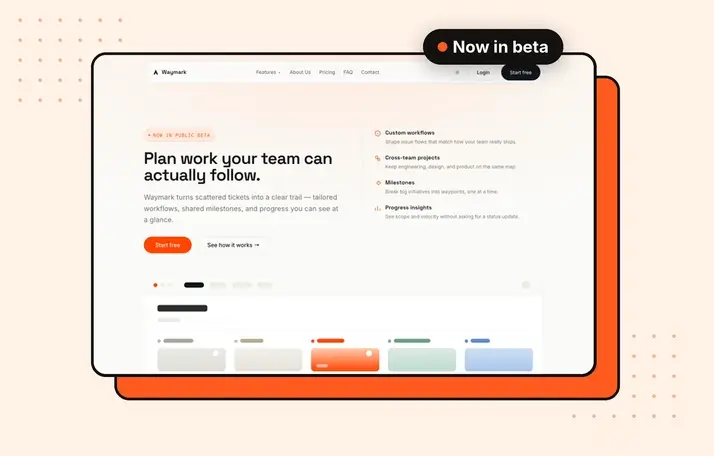
Waymark – Astro SaaS Template & Marketing Landing Page
Waymark is an Astro landing page template and SaaS landing page Astro template for workflow SaaS products, with eight pages, SPA-style navigation, and vanilla TypeScript, no client-side framework.
Use code FIRST30 at checkout — valid across every Bootstrap, Angular, React, Astro,
and Tailwind template.