
Waymark – Astro SaaS Template & Marketing Landing Page
Waymark is an Astro landing page template and SaaS landing page Astro template for workflow SaaS products, with eight pages, SPA-style navigation, and vanilla TypeScript, no client-side framework.



Overview
- About Waymark (Astro)
- Why Choose Waymark for a SaaS Landing Page
- Key Features of Waymark (Astro)
- Typed From Data to Markup
- Readable and Minified Builds
- Why SPA Transitions Without a Framework
- A Type System Built for a Workflow Product
- MDX-powered Content, Where It's Needed
- A Route for Every Stage of the Funnel
- Who Should Use Waymark (Astro)
- Specifications and Support
- Conclusion
- Related templates
About Waymark (Astro)
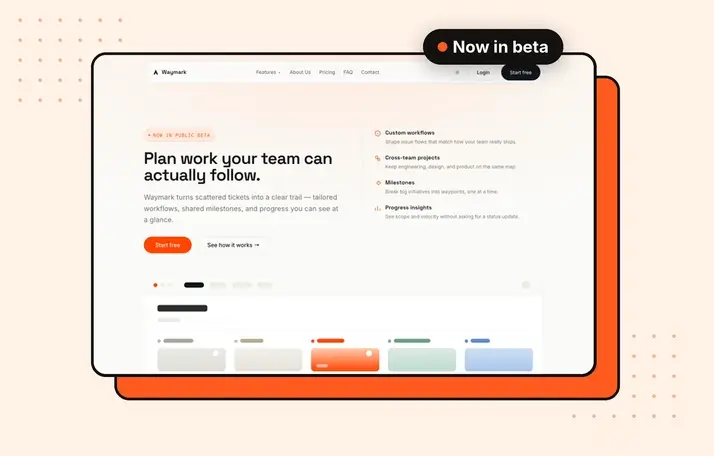
A project and workflow SaaS product needs a marketing site that explains itself in seconds: what it replaces, how teams adopt it, and why it's worth paying for once the trial ends. Waymark — Astro Marketing Landing Page Template is built exactly for that job — a focused, eight-page web app landing page for tools that help teams plan and track their work, covering the entire journey from a cold visitor's first impression to a completed signup.
Waymark is built with Astro 7, Tailwind CSS 4 and vanilla TypeScript, compiled to fast, ready-to-upload pages with Astro's ClientRouter providing SPA-style page transitions without pulling in a client-side framework. There's no React, no jQuery — just typed data, typed components, and small per-behavior scripts that keep the page interactive where it needs to be and otherwise get out of the way.
Why Choose Waymark for a SaaS Landing Page
Every piece of copy in Waymark lives in typed JSON data files, read through typed getter functions such as getHome() rather than being hardcoded directly into markup. That separation makes the template genuinely easy to re-brand and re-word for a different product without touching component code at all — swap the JSON, keep the layout. Strict folder boundaries, where UI components never import from page-section or core components, keep the codebase easy to extend months after the initial build rather than accumulating the kind of cross-imports that make a landing page fragile to change.
The eight pages — home, features, pricing, about, FAQ, contact, login and signup — cover the full top-of-funnel-to-signup journey a SaaS product needs before a real application takes over post-login. A visitor can land on the homepage, read through the feature breakdown, check pricing, resolve any objections through the FAQ, and either sign up directly or reach out through the contact page first, all without leaving the marketing site.
Key Features of Waymark (Astro)
Eight Essential SaaS Pages
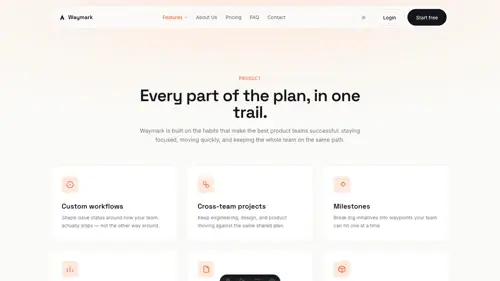
Home, Features, Pricing, About, FAQ, Contact, Login and Signup are all included, pre-written with workflow and project-management-style copy that's straightforward to adapt to other SaaS categories without restructuring the pages themselves.
SPA-style Navigation Without a Framework
Astro's ClientRouter delivers smooth, app-like page transitions while the site remains a collection of pre-rendered pages under the hood, with vanilla TypeScript handling the small amount of client-side behavior each page needs.
Fully Typed Content Layer
All copy lives as typed JSON, with a shared types.ts describing every page's shape and typed service getters used by components — rewriting copy for a rebrand never means touching a component file, only the data behind it.
Working Contact Form
A PHP-backed contact form (public/contact.php) is included for environments where a simple server-side mail handler is preferred over wiring up a third-party email API.
Consistent Design Tokens Across Pages
Brand color, type scale and spacing are defined once as design tokens rather than repeated per page, so a rebrand that changes the accent color or the heading font touches a single source of truth instead of requiring a find-and-replace across eight separate page files.
Splide-powered Carousels, Just Validate for Forms
Where the page needs a logo carousel or testimonial slider, Waymark uses Splide — a small, dependency-light carousel library rather than a full animation framework — and form validation on the contact, login and signup pages runs through Just Validate, a similarly lightweight library that keeps validation logic declarative without pulling in a larger form-management framework the page doesn't otherwise need.
Clean, Fast-Loading Pages
The site builds with Astro's format: "file" output, so every page is a clean, ready-to-upload .html file — about.html, pricing.html and so on — deployable to any web host without directory-index routing.
Login and Signup Flows Ready for a Backend
The Login and Signup pages are built out with full form validation and layout, ready to be wired to a real authentication backend when the product behind the marketing site is ready to launch.
Accessibility and Performance Auditing Built In
An included audit script runs Astro's audit rules against the built pages through headless Chrome, producing a report the team can check before shipping so accessibility and performance regressions get caught before a real visitor does, rather than being discovered after launch from a support ticket or a dropped Lighthouse score.
Typed From Data to Markup
Every page's content — headlines, feature descriptions, pricing tiers, FAQ entries — is described by an interface in types.ts and lives as a matching JSON file, read through a typed getter like getPricing() rather than imported ad hoc. That typing means a rebrand that changes copy, reorders pricing tiers, or adds an FAQ entry is caught by the TypeScript compiler if the new data doesn't match the expected shape, instead of silently rendering a broken section in the browser. It also means two people can work on Waymark at once without colliding: one editing the JSON content, the other editing the components that render it, with the type definitions as the contract between them.
The project enforces this discipline structurally as well as by convention: UI-layer components never import from page-section or layout components, and page-section components never reach into another section's internals. That one-directional dependency graph is what keeps a template like this maintainable past the first few months, when most landing page codebases start accumulating exactly the kind of tangled cross-imports that make a seemingly small change risky.
Readable and Minified Builds
Like its Tailwind-HTML sibling, Waymark (Astro) can produce either a minified production build or a readable debug build with real class names and unminified output intact. That matters most when a visual bug only shows up in the production bundle — a readable build lets a developer inspect exactly what shipped instead of reverse-engineering minified output to find the source of the problem.
Why SPA Transitions Without a Framework
Astro's ClientRouter intercepts same-origin link clicks and swaps the page content with a transition instead of forcing a full reload, giving Waymark the perceived smoothness of a single-page app while every page is still generated as a separate, instantly loading HTML file at build time. That combination — SPA-feeling navigation with none of the client-side routing logic, state management or bundle size a real SPA framework would require — is the core trade-off Waymark is built around, and it's the reason the template can promise a polished feel without asking a team to adopt React just for a marketing site.
A Type System Built for a Workflow Product
Inter, Space Grotesk and IBM Plex Mono are paired across body copy, headings and the occasional code or data-style detail respectively — the kind of type pairing project-management and workflow tools tend to use to signal both approachability and technical seriousness at once, rather than leaning entirely toward one or the other.
MDX-powered Content, Where It's Needed
The project includes @astrojs/mdx and @astrojs/sitemap alongside its core dependencies, so any future long-form content — a help article, a changelog entry, a case study — can be authored in Markdown with embedded components rather than hand-written HTML, while the sitemap stays automatically generated and accurate as pages are added.
A Route for Every Stage of the Funnel
Mapping the eight routes onto the buyer's journey makes the page set's logic explicit: Home and Features handle the top of the funnel, Pricing and FAQ handle objection-resolution, About builds trust, Contact catches visitors who want a conversation before committing, and Login/Signup close the loop into the real product. Nothing in that set is there for decoration — each page earns its place by handling a specific stage a cold visitor actually goes through before becoming a signed-up user.
Who Should Use Waymark (Astro)
Waymark suits SaaS teams — particularly project management, workflow and productivity tools — that want a fast, typed, framework-light landing page they can fully re-brand without inheriting React or a heavier build pipeline. It's equally well suited to a team that already runs other Astro properties and wants this one to follow the same conventions — the typed content layer, the import boundaries, the file-based output — rather than introducing a one-off pattern just for a single page, and it's a good match for anyone who wants a real accessibility and performance check before every release but doesn't want to set that tooling up themselves, since the audit script is already wired to the build.
As an Astro landing page template in the narrowest sense of the phrase, Waymark isn't an Astro theme stretched to also cover a blog or a portfolio — just the eight pages a SaaS signup funnel actually needs, a different design brief than most general-purpose Astro website templates are built around. Teams deciding between the three Waymark builds should weigh how their own stack is already standardized: the most value from matching conventions here goes to a team with an existing Astro codebase, while a team already on Next.js or wanting zero build tooling at all in production will likely prefer one of the sibling builds — also available with shadcn/ui, or as plain HTML via Gulp — each sharing the identical eight-page structure and copy.
Waymark is part of LettStart Design's Astro themes, Astro templates, Astro website templates and best Astro templates collection. It also belongs in the Astro SaaS template, landing page template and SaaS landing page template categories, so you can compare it with similar templates in the same range.
Specifications and Support
Waymark is made by LettStart Design, and the details below come straight from the template package. It is built with Astro 7.4, Tailwind CSS 4.3 and TypeScript. Documentation is available before you buy.
- 8 Pages Included
- SaaS: Project & Workflow Focus
- SPA Feel: Astro ClientRouter
- No Framework: Vanilla TypeScript
- Tech Used: Astro 7, TypeScript, Tailwind CSS 4
- Forms: PHP-backed Contact Form
- Content: Fully Typed JSON Data Layer
- Output: Clean Flat .html Pages
Waymark (Astro) is an Astro SaaS template and Astro landing page template for workflow products. It is one of the Astro templates built for a startup landing page template use case, with the eight pages a signup funnel needs.
Conclusion
Waymark delivers a clean, typed, SPA-feeling SaaS landing page in pure Astro and TypeScript — every page a real SaaS product needs before login, with none of the overhead of a client-side framework.
Related templates
The modules, laid out like the product itself
All 10 highlights, grouped the way they appear in Waymark – Astro SaaS Template & Marketing Landing Page's own sidebar.
Eight Pages: Home, Features, Pricing, About, FAQ, Contact, Login, Signup
SPA-style Page Transitions via Astro ClientRouter
Fully Typed JSON Content Layer
No React, No jQuery, Vanilla TypeScript
Splide Carousels + Just Validate Forms
Working PHP Contact Form
Clean, Fast-Loading Pages (Flat .html Files)
Strict Component Import Boundaries (UI / Core / Site)
Built-in Accessibility and Performance Audit Script
Astro 7 + Tailwind CSS 4
What buyers are saying
No reviews yet — be the first to share your experience.
Before you get started
Waymark is an Astro landing page template for project and workflow SaaS products, with eight pages, SPA-style navigation and vanilla TypeScript, built narrower than most general-purpose Astro templates.
No. Waymark is built with Astro and vanilla TypeScript only, with Astro's ClientRouter providing SPA-style transitions.
All copy lives in typed JSON data files read through typed getter functions, so re-branding the template does not require editing component code.
Yes, a PHP-backed contact form is included and can be run locally via the project's PHP serve command.
Yes, the same Waymark product is also available built with Next.js and shadcn/ui, and as plain HTML with Tailwind CSS compiled via Gulp.
Yes. Waymark is an Astro landing page template and SaaS landing page Astro template purpose-built as a startup landing page template for workflow and project-management SaaS products, covering Home, Features, Pricing, FAQ, Contact, Login and Signup.
Waymark belongs to LettStart Design's Astro themes, Astro templates, Astro website templates and best Astro templates collection and is also suited to Astro SaaS template, landing page template and SaaS landing page template use cases.
Change log
- Initial release
- Astro 7, Tailwind CSS 4, vanilla TypeScript
- Eight pages with SPA-style navigation
- Working PHP contact form, clean flat-file page output
Waymark – Astro SaaS Template & Marketing Landing Page in other frameworks
Waymark – Tailwind Website Template, Marketing Landing Page
Waymark is a Tailwind landing page template and Tailwind SaaS template for workflow SaaS products, built with Tailwind CSS 3.4, Gulp and vanilla JavaScript, no framework or build runtime. Part of our Tailwind CSS templates range.
Waymark – Next.js Website Template for SaaS Marketing
Waymark is a Next.js landing page template and Next.js SaaS template for workflow SaaS products, built with shadcn/ui on Base UI and Tailwind CSS 4, launch-ready for Apache or any web host. Part of our Next.js templates range.
Related templates
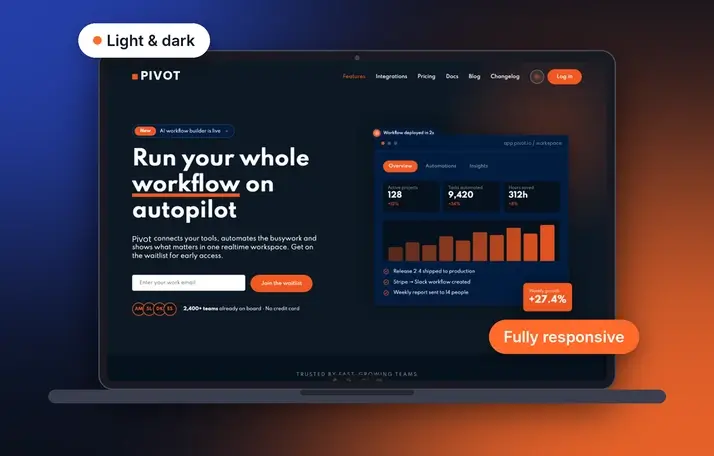
Pivot – Astro SaaS Template & Startup Landing Page
Pivot is an Astro SaaS template and SaaS landing page Astro template with no React runtime, a dark mode SaaS landing page theme, docs, changelog, and PHP-backed waitlist forms.
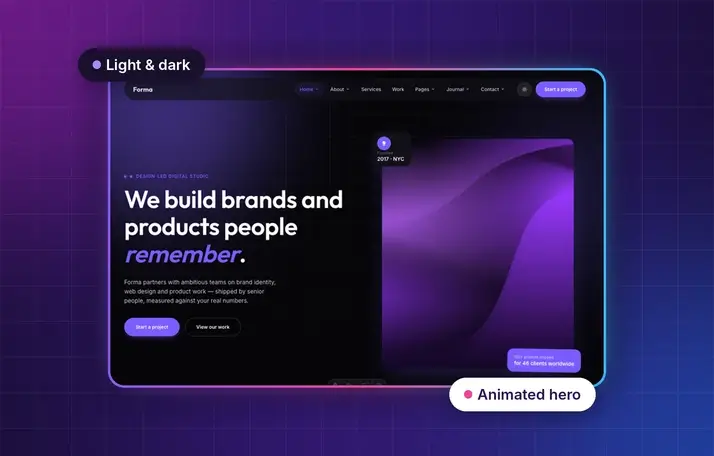
Forma – Astro Portfolio Template for Agency & Studio
Forma is an Astro portfolio template and Astro agency website template with no React runtime, a Digital Violet design system, five home page variants, and a case study portfolio template built in.
Use code FIRST30 at checkout — valid across every Bootstrap, Angular, React, Astro,
and Tailwind template.