
Pivot – Astro SaaS Template & Startup Landing Page
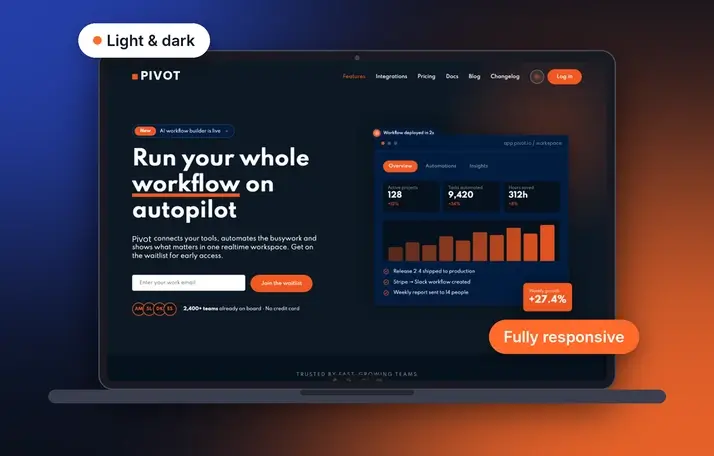
Pivot is an Astro SaaS template and SaaS landing page Astro template with no React runtime, a dark mode SaaS landing page theme, docs, changelog, and PHP-backed waitlist forms.




Overview
About Pivot
Launching a SaaS product means shipping a marketing site fast, and shipping it without it looking like every other gradient-hero template on the market. Pivot — Astro SaaS & Startup Landing Page Template is built for workflow and productivity tools that need a confident, modern, dark-themed presence from day one — a hero that states the pitch clearly, a feature showcase that shows rather than tells, pricing, a working waitlist, and the content infrastructure (blog, docs, changelog) a real launch actually needs around the homepage.
Pivot is built with Astro 7 and Tailwind CSS 4 only — there is no React, Vue or any other UI framework anywhere in the project. Every section, including the Bento-style feature grid, the Animated Beam integration visual, the logo marquee and the animated Number Ticker stats, is a native .astro component that reproduces the Magic UI look and motion without shipping a client-side framework runtime to do it. The handful of places that need real interactivity — the auth modal, the mobile drawer, the theme toggle, live form validation — are handled by small vanilla TypeScript initX() modules loaded once from the navbar, not by hydrated components.
Why Choose Pivot for a SaaS Launch
Because nothing on the page ships as a hydrated island, Pivot has no hydration cost to reason about at all: every section is plain, pre-rendered Astro markup, and the small amount of behavior a SaaS landing page actually needs — opening the auth modal, validating the waitlist form, toggling the theme — runs from lightweight scripts that attach after the HTML is already on the page. That keeps the site fast on first paint without the islands-and-hydration complexity a React-based competitor would carry.
The waitlist and demo-request forms post straight to public/api/waitlist.php and public/api/demo.php, which email the submission using PHP's built-in mail() function — no third-party email API, API key or external service required. Setting the recipient address is a one-line edit in each file, and most shared PHP hosting already has a working mail() setup, so the whole lead-capture flow works the moment the site is deployed.
Key Features of Pivot
Full Content System: Blog, Docs and Changelog
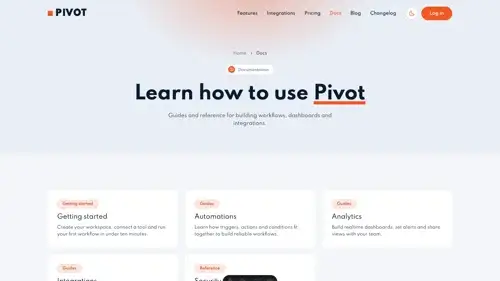
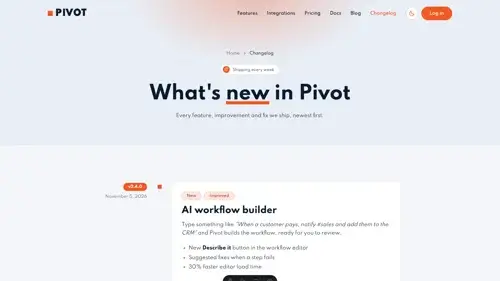
Beyond the marketing homepage, Pivot includes a working blog with six real starter posts and individual post pages, a documentation section with five guides (getting started, security, integrations, analytics and automations), and a changelog page with real version entries — the content scaffolding most SaaS products need around launch but rarely get around to building before they ship.
Native-Astro Magic UI-Style Motion
A bento-style feature grid, an animated beam connecting integration logos, a scrolling logo marquee, and an animated number ticker for stats bring the homepage to life — each one rebuilt from scratch as a plain Astro component rather than imported from a React motion library, so the visual language of Magic UI survives without the framework weight.
Pricing and Waitlist Sections
A dedicated pricing section presents plan tiers clearly, and a standalone waitlist section captures interest from visitors who aren't ready to commit yet, both wired into the same PHP-backed lead pipeline as the demo-request flow.
Dark and Light Theme
A full light/dark theme system with design tokens — a defined brand palette, a Spartan display font, and a consistent section rhythm, all centralized in src/styles/tokens.css — keeps the page visually coherent whichever mode a visitor's system or preference puts them in.
Authentication UI Ready to Connect
Sign-in, sign-up and forgot-password modal UI, with client-side validation, is implemented end to end in src/features/auth/; no backend is wired up yet, so connecting a real auth provider is a matter of plugging logic into that one folder rather than building the UI from scratch.
SEO and JSON-LD Built In
Structured data builders live in src/lib/seo.ts and brand/SEO text is centralized in src/lib/site.ts, so launching with correct SEO metadata across the homepage, blog and docs doesn't require touching every individual page. Every internal link is routed through a shared withHref() helper so the site keeps working correctly when deployed under a non-root base path.
Why Zero Hydration Matters Here
Most "Magic UI" style SaaS templates reach for that look by pulling in React specifically to get access to the Magic UI component library, then hydrating a Bento grid, a beam animation and a number ticker as client components on top of an otherwise lightweight page. Pivot gets the same visual result a different way: each of those effects is reimplemented as a small, self-contained Astro component using CSS animation and a short inline script where real interactivity (like the beam's path recalculation) is unavoidable. The practical difference shows up in the shipped JavaScript — there's no React runtime, no hydration bookkeeping, and no risk of a hydration mismatch between server-rendered and client-rendered markup, because nothing on the page is ever rendered twice.
That also simplifies customization. Changing the number of logos in the marquee, the copy on a pricing tier, or the steps in the "how it works" section means editing a typed data file or a single .astro component directly, without reasoning about which parts of a React component tree re-render when a prop changes. For a marketing site that will mostly be edited by whoever owns the copy rather than by a frontend specialist, that lower cognitive overhead is a real advantage over a heavier, framework-driven equivalent.
Deploying Under a Subdirectory
Pivot's astro.config.mjs sets both site and base, and every internal link in the project goes through the shared withHref() helper rather than being written as a raw absolute path. That one decision is what lets the same build run correctly whether it's deployed at the root of a domain or tucked under a themed subdirectory of a larger marketing site — exactly the setup this template itself ships under for its own live preview — without hunting down and fixing broken links page by page after the fact.
Content That Reads Like a Real Product
Rather than placeholder lorem-ipsum entries, Pivot's blog, docs and changelog ship with content written as though Pivot were a real, operating SaaS product: blog posts on topics like why the team built Pivot, how they keep it fast, and writing a changelog people actually read; documentation covering getting started, security, integrations, analytics and automations; and a changelog with dated entries for features like an AI workflow builder, real-time dashboards, and SSO with audit logs. That depth means a buyer previewing the template sees what a filled-in content section looks like at a glance, instead of having to imagine it from six identical "Post Title Here" placeholders.
Spartan, Not the Default Sans
Where most SaaS templates default to Inter or a system sans-serif stack, Pivot uses Fontsource's self-hosted Spartan across headings and body copy, giving the page a slightly more geometric, confident voice than the typeface everyone's already seen on a dozen other dark-mode SaaS sites, while still loading as a normal self-hosted web font with no third-party font CDN request to wait on.
Who Should Use Pivot
Pivot is built for SaaS founders, startups and product teams who need a credible, dark-themed marketing site with a blog, docs and changelog ready on day one, rather than bolting that content system on months after launch. It's a particularly strong fit for workflow, productivity and developer-tool products, where a confident, slightly technical visual language matches the audience's expectations better than a brighter, consumer-facing design — and it works just as well for a team pre-launch that needs a waitlist to validate demand as for one already in early access that needs a pricing page and changelog to show momentum.
It also suits teams who've been burned before by a template that looked polished in preview but turned into a maintenance headache the moment a junior developer touched a section and broke the hydration boundaries around it — there are none here to break, since nothing on the page is a hydrated island in the first place. And because the waitlist, demo request and auth modal are all usable from day one in their PHP/no-backend form, a team can launch the marketing site now and swap each one for a real API integration later, on its own timeline, without waiting on a backend that isn't ready yet. The one group Pivot doesn't suit as well is a team that wants React components shared between the marketing site and a React-based application shell, since there's nothing React here to share at the component level.
Pivot also sits at the overlap of two categories most Astro themes keep separate: it's built as an Astro SaaS template first, but its six-post blog, five docs and dated changelog entries are substantial enough to earn it a look as an Astro blog template too, worth weighing against whatever else turns up in a search for the best Astro templates right now.
Pivot is part of LettStart Design's Astro themes, Astro templates, Astro website templates and best Astro templates collection. It also belongs in the Astro SaaS template, landing page template and SaaS landing page template categories, so you can compare it with similar templates in the same range.
Specifications and Support
Pivot is made by LettStart Design, and the details below come straight from the template package. It is built with Astro 7.4, Tailwind CSS 4.3 and TypeScript. Documentation is available before you buy.
- SaaS: Landing Page
- Blog + Docs: Changelog Included
- No Framework: Native Astro Components
- Theme: Dark and Light
- Tech Used: Astro 7, Tailwind CSS 4
- Forms: PHP mail()-powered Waitlist/Demo
- Auth: UI Only, No Backend Wired
- SEO: JSON-LD and OG Metadata Builders
Pivot is built as an Astro landing page template for SaaS with no React runtime, so pages stay light. It combines an Astro SaaS template structure with a blog, docs, changelog and waitlist forms, and it fits among the Astro templates and Astro themes aimed at software products.
Conclusion
Pivot combines a striking, motion-rich SaaS landing page with the content infrastructure — blog, docs, changelog, PHP-backed lead capture — that a real product launch actually needs, built entirely on native Astro components with zero client-side framework overhead.
Related templates
The modules, laid out like the product itself
All 10 highlights, grouped the way they appear in Pivot – Astro SaaS Template & Startup Landing Page's own sidebar.
Hero, Bento Features, Pricing and Waitlist Sections
Working Blog with 6 Starter Posts
Docs Section (5 Guides) and Changelog Page
Native-Astro Magic UI-style Motion (Bento, Beam, Marquee, Ticker)
Dark and Light Theme
Auth Modal UI, No Backend Wired
PHP mail()-powered Waitlist and Demo-Request Forms
SEO Metadata and JSON-LD Builders
Zero Client-side Framework, No Hydration
Astro 7 + Tailwind CSS 4
What buyers are saying
No reviews yet — be the first to share your experience.
Before you get started
Pivot is an Astro SaaS template and Astro blog template for startup products, built with Tailwind CSS 4 and no client-side JavaScript framework, with dark/light themes, docs and a changelog.
Yes, the waitlist and demo-request forms post to PHP handlers that email the lead with PHP's mail() function; no third-party email service or API key is required.
Pivot has no React dependency. Its Bento grid, animated beam, marquee and number ticker are native Astro components built to match the Magic UI look without a framework runtime.
Pivot includes the sign-in/sign-up/forgot-password modal UI and client-side validation; connecting a real auth provider means adding logic to src/features/auth/.
Yes, Pivot ships with six starter blog posts, five documentation guides, and a changelog page with real version history entries.
Pivot is a dedicated Astro SaaS template and SaaS landing page Astro template, built dark-mode-first, with its blog, docs and changelog substantial enough to also work as a standalone Astro blog template.
Pivot belongs to LettStart Design's Astro themes, Astro templates, Astro website templates and best Astro templates collection and is also suited to Astro SaaS template, landing page template and SaaS landing page template use cases.
Change log
- Initial release
- Astro 7, Tailwind CSS 4, zero client-side framework
- Blog, docs and changelog included
- PHP mail()-powered waitlist and demo-request forms
Related templates
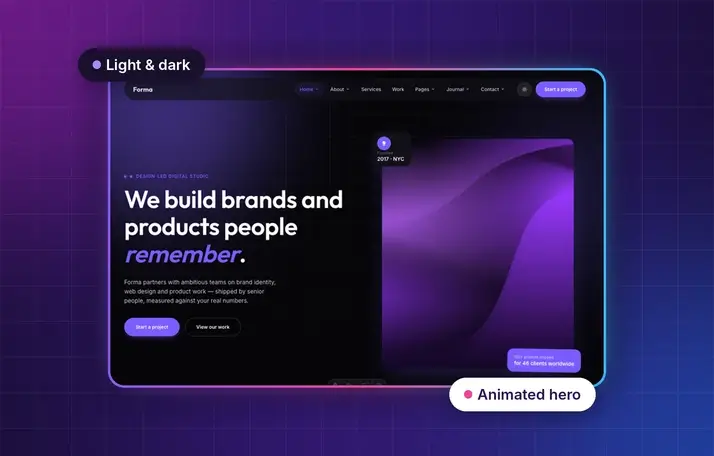
Forma – Astro Portfolio Template for Agency & Studio
Forma is an Astro portfolio template and Astro agency website template with no React runtime, a Digital Violet design system, five home page variants, and a case study portfolio template built in.
Waymark – Astro SaaS Template & Marketing Landing Page
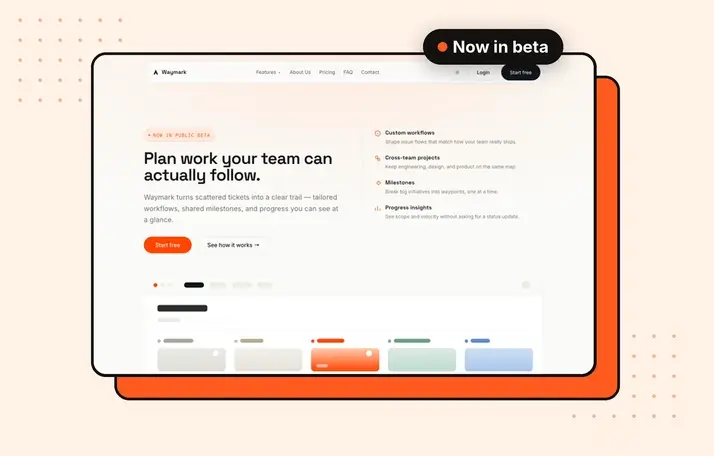
Waymark is an Astro landing page template and SaaS landing page Astro template for workflow SaaS products, with eight pages, SPA-style navigation, and vanilla TypeScript, no client-side framework.
Use code FIRST30 at checkout — valid across every Bootstrap, Angular, React, Astro,
and Tailwind template.