
Waymark – Next.js Website Template for SaaS Marketing
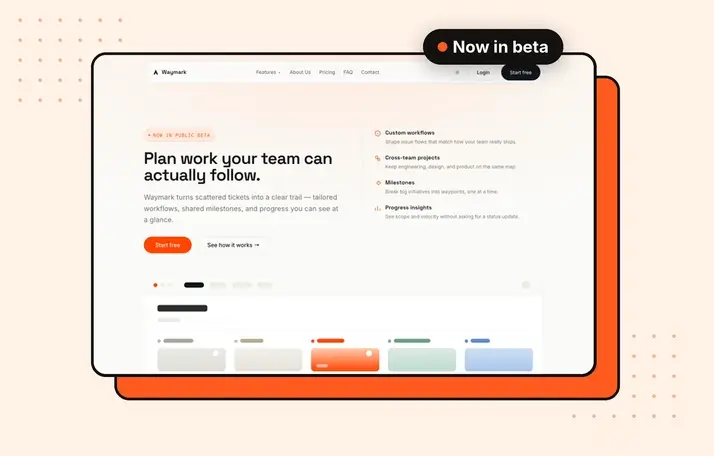
Waymark is a Next.js landing page template and Next.js SaaS template for workflow SaaS products, built with shadcn/ui on Base UI and Tailwind CSS 4, launch-ready for Apache or any web host. Part of our Next.js templates range.



Overview
- About Waymark (Next.js)
- Why Choose Waymark (Next.js) for an Apache Deployment
- Key Features of Waymark (Next.js)
- Production Speed Without Giving Up Next.js DX
- Light and Dark Mode via next-themes
- Lucide Icons Throughout
- Base UI Style, Neutral Base Color
- A Route for Every Stage of the Funnel
- Linting and Formatting Out of the Box
- Turbopack in Development
- Composable Carousel Context
- A Component Library, Not Just a Landing Page
- Who Should Use Waymark (Next.js)
- Specifications and Support
- Conclusion
- Related templates
About Waymark (Next.js)
Teams already standardized on Next.js and shadcn/ui shouldn't have to leave that stack just to ship a marketing site. Waymark — Next.js Marketing Landing Page Template brings the same eight-page project/workflow SaaS landing page as the Astro and Tailwind-HTML builds of Waymark to the Next.js App Router, styled with shadcn/ui and Tailwind CSS 4, and built to launch fast on any web host.
The build is designed to be dropped onto a plain Apache server — mod_rewrite and AllowOverride All for the included .htaccess, plus PHP for the contact form — so teams get Next.js's developer experience during development with none of its server runtime requirements in production.
Why Choose Waymark (Next.js) for an Apache Deployment
Design tokens (brand color, base styles) live in dedicated CSS files separate from component code, and content is split out into typed JSON per page with typed service getters, exactly matching the content architecture of the Astro version of Waymark. Component boundaries are enforced the same way: UI primitives never import from layout or page-section components, which keeps the same discipline that makes the Astro build easy to re-brand available here as well.
React context providers handle cross-cutting concerns like the auth modal and billing state, keeping page components focused on layout and copy rather than application state. Because the entire site still builds to ready-to-upload pages, none of this context usage requires a running Node server once the site is built and deployed.
Key Features of Waymark (Next.js)
Eight Essential SaaS Pages
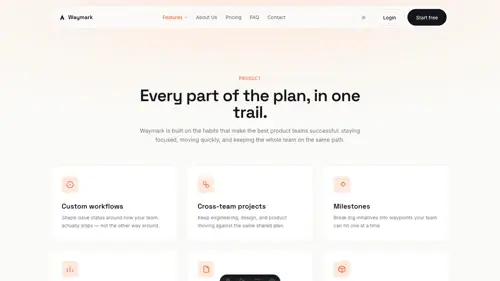
Home, Features, Pricing, About, FAQ, Contact, Login and Signup, matching the page set of the Astro and Tailwind-HTML Waymark builds so the product presents identically regardless of stack.
shadcn/ui Component Library on Base UI
Carousel, dialog, field, input, label, navigation menu, select, separator, sheet, table, tabs, textarea, toggle and other primitives are all included and themeable through the shared design tokens, built on shadcn's Base UI style rather than Radix.
Launch-Ready for Apache
The entire site builds to a ready-to-upload out/ folder for deployment to any Apache web root, with canonical URLs and JSON-LD generated at build time rather than at request time.
Typed JSON Content Layer
All copy lives in typed JSON per page area (home, about, pricing, FAQ, contact, features, auth), read through typed service getters — the same separation of content and markup used across every Waymark build, so a rebrand touches data files, not components.
Working PHP Contact Form
A PHP contact handler (public/contact.php) is included, with the recipient address configurable in one place and no third-party email service required to get it working.
React Hook Form and Zod Validation
Every form on the site — contact, login, signup — is wired through React Hook Form with Zod schemas describing the expected shape of valid input, so validation errors surface inline and consistently across every form rather than each page implementing its own ad hoc validation logic.
Embla Carousel for Logos and Testimonials
Logo strips and testimonial rows use Embla Carousel with its autoplay plugin rather than a heavier slider library, keeping the production bundle size down while still getting smooth, touch-friendly carousels on mobile devices.
Auth Modal and Billing State via React Context
Sign-in/sign-up modal visibility and billing-related UI state are managed through dedicated React context providers under src/providers/, keeping that logic out of individual page components and easy to extend as the real product's auth and billing needs grow.
Production Speed Without Giving Up Next.js DX
Running output: "export" means every route in Waymark (Next.js) — including the dynamic pieces powered by context providers — is pre-rendered to a flat HTML file at build time, with the custom image loader resolving asset paths against the configured base path the same way Atlas does. The practical effect is that the development experience stays exactly what a Next.js team already expects — the App Router, fast refresh, TypeScript end to end, shadcn's CLI for adding new primitives — while the production build is just ready-to-upload files an Apache server can serve with zero Node process running behind it.
That matters specifically for the included .htaccess, which handles the URL rewriting needed to serve clean paths without a trailing .html showing in the address bar, and which assumes mod_rewrite and AllowOverride All are available on the target Apache host — a configuration most shared hosting and VPS Apache setups support without any special request to a host provider.
Light and Dark Mode via next-themes
Theme switching is handled by next-themes rather than a hand-rolled context and localStorage combination, which also means the theme choice persists correctly across every pre-built page and avoids the flash-of-wrong-theme problem that a naive implementation often introduces on first paint.
Lucide Icons Throughout
Every icon across the eight pages — navigation, feature callouts, form affordances — comes from Lucide, matching shadcn/ui's own default icon library convention, so a team adding a new section later can pull from the same icon set instead of mixing icon styles from multiple libraries within one page.
Base UI Style, Neutral Base Color
The shadcn configuration pins the component style to base-nova on a neutral base color rather than Radix's default zinc or slate, which is the specific combination that gives Waymark (Next.js) a visual identity distinct from the countless other shadcn-based templates built on the Radix defaults most teams never bother to change.
A Route for Every Stage of the Funnel
The same eight routes map onto the buyer's journey as the Astro and Tailwind-HTML Waymark builds: Home and Features at the top of the funnel, Pricing and FAQ for resolving objections, About for trust, Contact for visitors who want a conversation before committing, and Login/Signup handing off into the real product. Keeping that structure identical across all three stacks means a team migrating from one Waymark build to another is porting markup and components, not re-deciding what the site's page set should be in the first place.
Linting and Formatting Out of the Box
ESLint's Next.js config and Prettier are both wired in from the start, so code style stays consistent as soon as a team starts editing, rather than needing to be set up from scratch before the first real commit to a cloned copy of the template.
Turbopack in Development
The dev server runs on Turbopack with a dedicated Tailwind v4 loader rule, so local iteration on styles and components stays fast even as the project grows, without needing a separate Webpack configuration maintained alongside it.
Composable Carousel Context
The Embla-based carousel component exposes its own React context so related UI — previous/next controls, pagination dots, autoplay toggles — can be built as separate, composable pieces around a single carousel instance rather than as a monolithic component with every control hardcoded inside it, matching the same composable pattern shadcn/ui uses for its other interactive primitives, and making it straightforward to add a new control to an existing carousel without touching the carousel's own internals at all.
A Component Library, Not Just a Landing Page
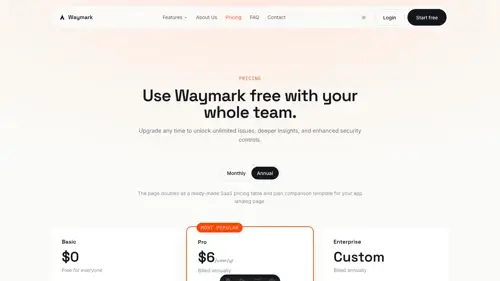
Because Waymark (Next.js) is built entirely from shadcn/ui primitives on the Base UI style, every interactive element on the page — the pricing toggle, the FAQ accordion, the mobile navigation sheet — is a documented, themeable component rather than a one-off bit of markup specific to this template. A team that later needs to build an additional page beyond the eight included here inherits the same component vocabulary, so that new page matches the rest of the site automatically instead of requiring new one-off styling.
Who Should Use Waymark (Next.js)
Waymark (Next.js) is built for teams already using Next.js and shadcn/ui who need a project/workflow SaaS landing page they can build once and deploy to traditional Apache hosting, without needing a Node server in production. It's a particularly strong choice for a team planning to build the actual logged-in product on the same stack, since the component vocabulary, the form-validation pattern and the context-based state management established here carry over directly into that application instead of needing to be re-learned later.
It's also a good fit for teams that expect to grow the marketing site into an actual product dashboard over time: because the component library, the typed content layer and the context-based state pattern are all genuine Next.js conventions rather than template-specific shortcuts, extending Waymark past its original eight pages follows the same patterns a team would already use to build the product itself. Teams who aren't yet committed to Next.js, or who want the absolute simplest production deployment, should look at the Astro or Tailwind-HTML builds of the same Waymark product instead — all three share the identical page set and copy, so the choice comes down to which stack the rest of the team is already standardized on.
Among the Nextjs templates and Next.js themes available for SaaS marketing, Waymark stays deliberately narrow: a Next.js landing page template with its eight-page structure already decided, rather than a blank Next.js website template still waiting to be filled in.
Waymark is part of LettStart Design's Next.js templates, Nextjs templates, Next.js website templates, Next.js Tailwind templates and Next.js shadcn template collection. It also belongs in the landing page template and SaaS landing page template categories, so you can compare it with similar templates in the same range.
Specifications and Support
Waymark is made by LettStart Design, and the details below come straight from the template package. It is built with React 19, Next 16.4, Tailwind CSS 4 and TypeScript. Documentation is available before you buy.
- 8 Pages Included
- SaaS: Project & Workflow Focus
- Export: Launch-Ready, Apache-friendly
- UI: shadcn/ui on Base UI
- Tech Used: Next.js 16, React 19, Tailwind CSS 4
- Forms: PHP-backed Contact Form
- Content: Fully Typed JSON Data Layer
- State: React Context (Auth Modal, Billing)
Waymark (Next.js) is a Next.js SaaS template and Next.js landing page template that suits teams already working in Next.js. Among Next.js templates and Next.js website templates it is a Next.js shadcn template with a fixed eight-page SaaS structure.
Conclusion
Waymark (Next.js) brings a polished, shadcn/ui-styled SaaS landing page to the Next.js App Router while still shipping as plain, fast-loading files — the same proven eight-page structure as the rest of the Waymark family, ready for Apache deployment.
Related templates
The modules, laid out like the product itself
All 10 highlights, grouped the way they appear in Waymark – Next.js Website Template for SaaS Marketing's own sidebar.
Eight Pages: Home, Features, Pricing, About, FAQ, Contact, Login, Signup
shadcn/ui Component Library on Base UI
Next.js 16 App Router, Launch-Ready Build
Apache-ready Deployment (.htaccess, mod_rewrite)
Typed JSON Content Layer with Typed Getters
React Context for Auth Modal and Billing State
React Hook Form + Zod Validation
Working PHP Contact Form
Design Tokens Separated from Component Code
Same Product Also Available in Astro and Plain HTML
What buyers are saying
No reviews yet — be the first to share your experience.
Before you get started
Waymark (Next.js) is a Next.js landing page template, launch-ready for project and workflow SaaS products, built with shadcn/ui on Base UI and Tailwind CSS 4 rather than a generic Next.js website template.
No. The site ships as ready-to-upload files intended for a standard Apache web root; Node is only used during the build.
Yes, a PHP-based contact form is included; the recipient address is configurable in a single file.
All copy lives in typed JSON files per page area, read through typed service getter functions, matching the content architecture used in the Astro version of Waymark.
Yes, Waymark is available in Next.js, Astro and a plain Tailwind HTML build, all sharing the same eight-page structure and content.
Yes. Waymark (Next.js) is a Next.js landing page template, Next.js SaaS template and Next.js shadcn template in one, built on shadcn/ui components with Base UI styling and launch-ready for Apache deployment.
Waymark belongs to LettStart Design's Next.js templates, Nextjs templates, Next.js website templates, Next.js Tailwind templates and Next.js shadcn template collection and is also suited to landing page template and SaaS landing page template use cases.
Change log
- Initial release
- Next.js 16 App Router, shadcn/ui on Base UI, Tailwind CSS 4
- Launch-ready for Apache deployment
- Eight pages, working PHP contact form
Waymark – Next.js Website Template for SaaS Marketing in other frameworks
Waymark – Astro SaaS Template & Marketing Landing Page
Waymark is an Astro landing page template and SaaS landing page Astro template for workflow SaaS products, with eight pages, SPA-style navigation, and vanilla TypeScript, no client-side framework.
Waymark – Tailwind Website Template, Marketing Landing Page
Waymark is a Tailwind landing page template and Tailwind SaaS template for workflow SaaS products, built with Tailwind CSS 3.4, Gulp and vanilla JavaScript, no framework or build runtime. Part of our Tailwind CSS templates range.
Related templates
Atlas – Next.js E-commerce Admin Dashboard Template
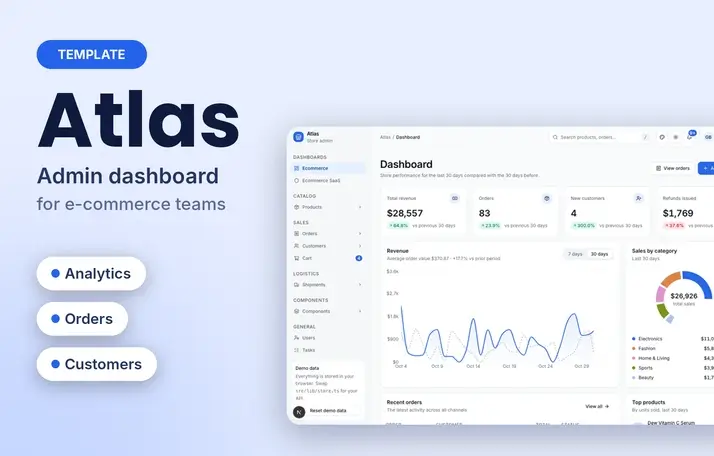
Atlas is a Next.js admin template and Next.js ecommerce admin dashboard built with shadcn/ui on Base UI, covering products, orders, shipments and customers, launch-ready with no backend needed.
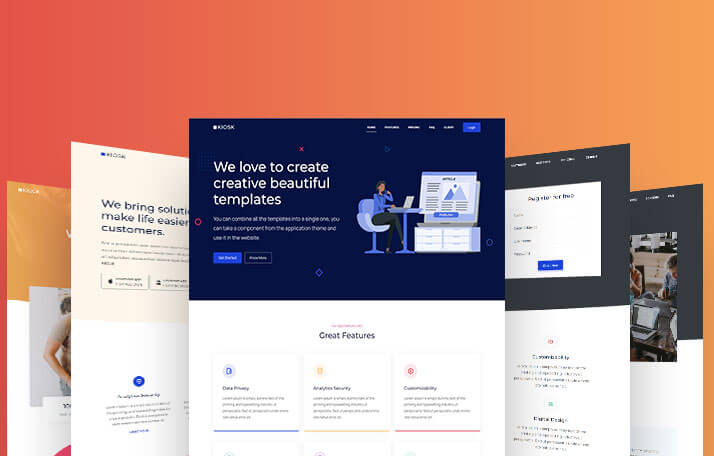
Kiosk – React & Next.js Landing Page Template
Kiosk is a Next.js landing page template and React template with portfolio and SaaS layouts, built on Next.js 15, React 19, responsive and SEO-ready. Part of our Next.js templates range.

PORTO – React Next.js Website & App Landing Page Template
PORTO is a multipurpose React Next.js website template for app landing pages, startups, portfolios, SaaS products and agencies. Part of our Next.js templates range.

ORYO – React & Next.js Templates for SaaS & Startups
ORYO is a React and Next.js template collection for SaaS products, startups and apps, with responsive, SEO-friendly landing pages. Part of our Nextjs templates range.

Rekto – React Next.js Landing Page Template for Digital Agencies
Rekto is a modern React Next.js landing page template for digital agencies, consultancies and IT services, with a clean single-page design. Part of our Next.js templates range.

ECOM – Next.js Website Template for E-Commerce Stores
ECOM is a React Next.js e-commerce website template with product listings, cart and checkout flow for launching an online store. Part of our Next.js templates and Nextjs templates range.

Proctu – Hospital Admin Dashboard Template, Next.js & React
Proctu is a React Next.js admin template for hospital management, patient dashboards, doctor panels and healthcare dashboard applications. Part of our Next.js templates and admin dashboard template range.
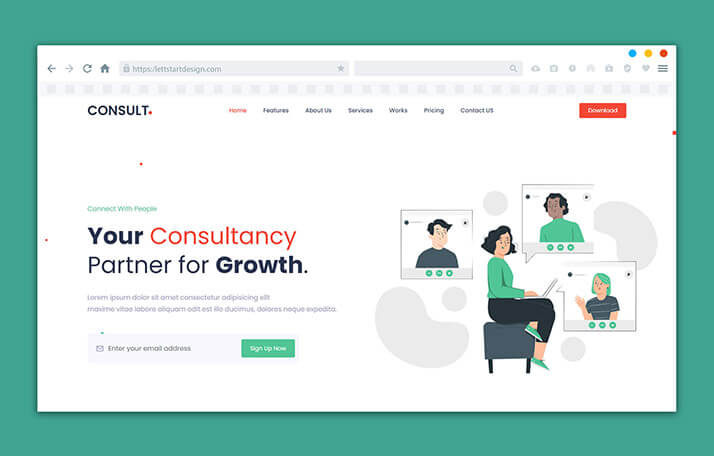
Consult – Next.js Landing Page Template for Consultancy & Agency
Consult is a responsive Next.js landing page template for agencies, consultancies, IT services and consulting firms. Part of our Next.js templates range.
Use code FIRST30 at checkout — valid across every Bootstrap, Angular, React, Astro,
and Tailwind template.